Feature 87 · Tuesday 24 November 2026
Shinkai
The 55-metre explorer yacht designed around a private submarine.
- Length
- 180 ft 1 in54.90 mBuilder’s source
- Completed
- 2021Operational 2022Builder’s source
Research & acknowledgements
Independently researched using publicly available material from Feadship, Vitruvius Yachts, U-Boat Worx, Gyro Marine, e3 Systems, polar-navigation researchers, specialist maritime publications and dated AIS records. No direct assistance, endorsement, approval or collaboration was obtained from the owner, captain, crew, builders, suppliers or photographers specifically for this article.
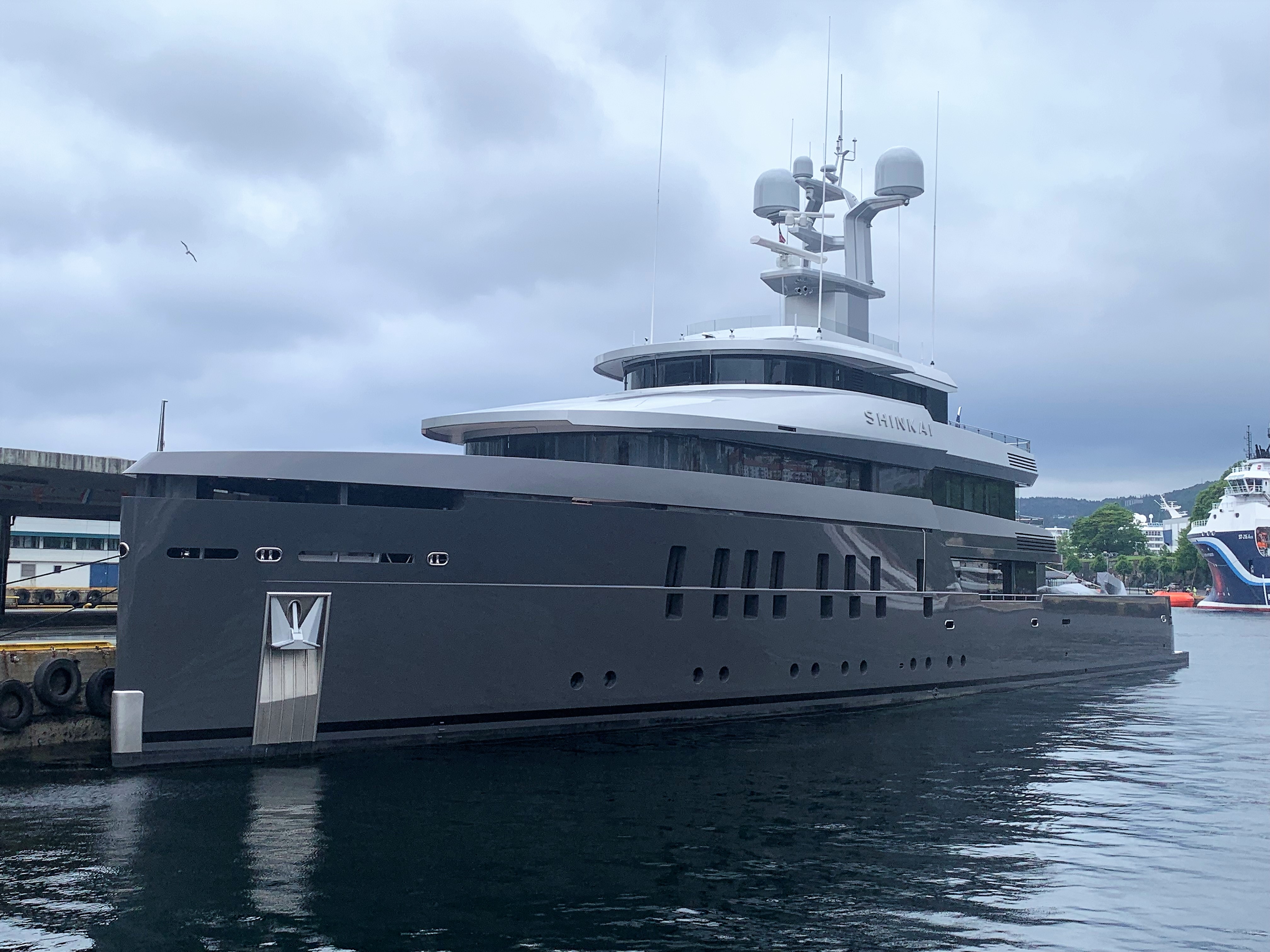
Historical image · Shinkai in Bergen, Norway · . This shows her appearance then, not her current condition.
Photo credit & licence
Photo: Cavernia · 9904558 Shinkai 2021.jpg · CC BY-SA 4.0
Unchanged original JPEG, displayed uncropped. No edits or resizing of the file.
The exact Commons record identifies Feadship Shinkai, IMO 9904558, photographed in Bergen on 23 June 2022. The 2021 in the file title is the build year, not the photograph date. Identity reference. Reviewed .
This photograph records the yacht’s appearance when it was taken.
Photo: Cavernia · 9904558 Shinkai 2021.jpg · CC BY-SA 4.0. Unchanged original, displayed uncropped.
Shinkai at a glance
- Guests
- 10–12source-dependentSourceChecked
- Cabins
- 5–6source-dependentSourceChecked
- Crew
- 12SourceChecked
- Cruising speed
- 12 knotsSourceChecked
- Maximum speed
- 14–14.5 knotssource-dependentSourceChecked
- Published range
- 5,500 nm at 12 knotsSourceChecked
- Gross tonnage
- 974 GTSourceChecked
Capacity depends on the operating arrangement. A cabin count is not a guest limit. See the specifications and range notes.
A Dutch-built ice-strengthened explorer combining extraordinary stabilisation engineering, underwater exploration, practical expedition equipment and a proven Northwest Passage transit.
Shinkai is a 54.9-metre custom Feadship explorer yacht completed in 2021. Designed by Philippe Briand and Vitruvius Yachts in collaboration with Feadship De Voogt, she was developed around her owner's U-Boat Worx C-Researcher 3 submersible. Her expedition capabilities include a substantial lifting crane, a large gyroscopic stabiliser, ice-strengthened construction, specialist sonar, substantial tenders and provision for carrying a Toyota Land Cruiser. In 2023, Shinkai completed a documented westbound transit of the Northwest Passage before continuing into the Pacific. Her recent operating record includes extensive cruising around Southeast Asia.
Settle in for the complete feature →Feature 87 ·
SHINKAI: THE SUPERYACHT BUILT AROUND A SUBMARINE, WITH A 23-TONNE GYROSCOPE AND A LAND CRUISER IN THE GARAGE
Most people commission a superyacht and then decide which toys to put aboard. Shinkai's owner bought the submarine first. What followed was an extraordinary engineering project involving an ice-strengthened steel hull, one of the largest yacht stabilisation gyroscopes ever installed, a crane certified to lift people inside a submarine, and an explorer that subsequently completed the Northwest Passage. Now she's exploring Indonesian waters, thousands of nautical miles from the Arctic.
Tuesday 24 November 2026 | Proper explorer yacht, submarine engineering and Arctic expedition special | Approximately 18–21 minutes for the main feature, followed by the website profile
In this story
Original reference caption: The real Shinkai, including Feadship's aerial and stern photographs from her sea trials. Notice the extraordinary amount of working deck devoted to expedition equipment rather than sun loungers. These professional photographs are reference-only pending individual publication permission.
PART ONE: THE COMPLETE MORNING FEATURE
☕ Good morning! Somebody finally built a yacht around the submarine.
Oh, this is going to be a good morning.
After several days investigating historical ships, steam engines, environmental research vessels and yesterday's hydrogen-powered catamaran, we're returning to a proper purpose-built luxury explorer.
And today's yacht contains several of my favourite things.
A proper little submarine.
An enormous crane.
A Land Cruiser.
Ice-strengthened construction.
Some wonderfully unusual mechanical equipment.
And, most importantly, a genuine record of going somewhere interesting.
Because this isn't one of those yachts described as capable of exploring the entire planet, which subsequently spends every summer travelling between Monaco and Saint-Tropez.
She actually went through the Northwest Passage.
There are photographs.
Reports from her captain.
Technical records of her communications systems during the expedition.
And an independent polar-navigation register confirming the completed transit.
Then she went to Hawaii.
Then Tahiti.
And during 2026 she has been travelling around Southeast Asia.
Now, here's the thing that makes her particularly interesting.
When the owner approached Feadship about building his new yacht, he'd already ordered his submarine.
Which is an absolutely magnificent way of approaching yacht ownership.
Rather than asking the designers where they could squeeze a little submersible into an existing layout, he effectively presented them with a substantial piece of underwater machinery and asked them to design a yacht around it.
The submarine needed to be easy to access.
The launching system needed to be exceptionally capable.
The yacht needed to remain stable while operating it.
And the owner wanted to travel into ice-affected waters, which introduced another complication.
Conventional stabiliser fins protrude from the hull. They could potentially be damaged by ice.
So the original design used an enormous internal gyroscope instead.
A machine weighing approximately:
23 TONNES.
That's heavier than several ordinary cruising yachts.
Just for the stabilisation system.
And then, because apparently the submarine and the Arctic capability weren't quite sufficient, the owner wanted a proper four-wheel-drive vehicle too.
I really do approve of the priorities here. 😂
Our yacht is called SHINKAI, a Japanese name meaning deep sea, and she's a rather wonderful example of what happens when an experienced owner knows precisely what he wants to do with his boat.
📰 The TL;DR: Why Shinkai matters
-
She was designed around a submarine. The owner had already commissioned a U-Boat Worx submersible before finalising the mothership.
-
She has a genuine ice-strengthened steel hull, developed for high-latitude cruising rather than merely styled to look adventurous.
-
Her original stabilisation system weighs approximately 23 tonnes. A large Gyro Marine GM600 was specified to reduce roll without relying exclusively on external fins.
-
Her submarine can reach 480 metres, carrying three people and offering a manufacturer-published submerged endurance of up to 16 hours.
-
Her aft deck is a proper expedition platform, incorporating a substantial crane, tenders and storage for a Toyota Land Cruiser.
-
She completed the Northwest Passage in 2023. Independent navigation records identify her westbound transit as entry 382 in the historical compilation.
-
Her Arctic communications equipment was genuinely tested, with satellite connectivity monitored as far north as approximately 74°N.
-
She has already undergone a documented refit. Feadship records new stabilisers, diving-equipment storage and underwater coating work in 2022.
-
She remains operational in 2026, with dated observations in Singapore, Bali and the Banda Sea.
-
She is remarkably compact for her capabilities. All this equipment fits aboard a yacht measuring just under 55 metres and 1,000 GT.
🛥️ Shinkai at a glance
54.9 m
180 ft 1 in overall
974 GT
Gross tonnage
5,500 nm
Published range at 12 knots
480 m
Submarine depth rating
23 t
Original gyro weight
2021
Build year
| Specification | Published information |
|---|---|
| Current name | SHINKAI |
| Project identity | Project 708 |
| Builder | Feadship, Royal De Vries |
| Construction location | Aalsmeer, Netherlands |
| Yard number | 708 |
| Launch | October 2021 |
| Exterior design | Philippe Briand / Vitruvius Yachts |
| Naval architecture | Vitruvius and Feadship De Voogt |
| Interior | Boutsen Design |
| Length | 54.90 m / 180 ft 1 in |
| Beam | 10.33–10.35 m / approximately 33 ft 11 in |
| Draught | 2.99 m / approximately 9 ft 10 in |
| Gross tonnage | 974 GT |
| Hull | Ice-strengthened steel |
| Superstructure | Aluminium |
| Main engines | 2 × MTU 12V 2000 M72 |
| Engine power | 1,080 kW each |
| Generators | 2 × Zenoro 208 kW electrical |
| Cruise speed | 12 knots |
| Maximum speed | 14–14.5 knots |
| Published range | 5,500 nm at 12 knots |
| Fuel capacity | 159,224 litres, current builder listing |
| Alternative fuel capacity | 140,000 litres, earlier specification |
| Freshwater capacity | 31,923 litres, current builder listing |
| Alternative freshwater capacity | 25,000 litres |
| Guests | 10–12, source-dependent |
| Guest cabins | 5–6, source-dependent |
| Crew | 12 |
| Classification society | Bureau Veritas |
| Submarine | U-Boat Worx C-Researcher 3 |
| Permanent IMO | 9904558 |
| MMSI | 538071658 |
| Call sign | V7A5029 |
| Flag | Marshall Islands |
| Permanent shadow vessel | None established |
The builder's present specification is preferred for machinery and tankage. Earlier figures are retained because they differ materially, and the current certified tank plans have not been inspected.
🇳🇱 The owner who bought the submarine first
There's something particularly interesting about owners who commission a second or third custom yacht.
They've already discovered the things that work, the things they rarely use and the things they wish somebody had thought about before construction began.
Shinkai's commissioning owner had previously worked with naval architect Philippe Briand. For this project, the ambition was to travel farther afield and make underwater exploration a central part of family life aboard.
YachtBuyer reports that the idea developed around 2017, partly because the owner wanted to continue exploring underwater with his grandchildren as conventional scuba diving became less practical.
A private submersible offered another way of doing that.
U-Boat Worx confirms that the owner had already commissioned a C-Researcher 3 when the Feadship order was placed.
That is a genuinely interesting starting point for naval architecture.
Normally, a designer might establish the yacht's size, accommodation, performance and general arrangement before allocating room for particular equipment.
Here, one of the most important pieces of equipment was already defined.
Its weight, physical dimensions, access arrangements and lifting requirements all influenced the design.
Even the shape of the aft deck needed to accommodate it.
Feadship and Vitruvius were therefore designing an integrated expedition system, not simply a luxury yacht with an impressive collection of accessories.
And the resulting vessel looks like it means business.
🏗️ The hull: Nearly 1,000 GT in just 55 metres
Shinkai is relatively broad and voluminous for her length.
Her 10.33-metre beam and 974 GT provide the internal space needed for substantial machinery, storage, comfortable accommodation and the structural requirements of the expedition equipment.
But there's an important distinction here.
GT measures enclosed volume through an internationally defined calculation. It isn't the weight of the yacht.
In Shinkai's case, the designer's historical technical figures separately identify approximately 746 tonnes in lightship condition and 983 tonnes at full load.
Those figures tell us something about mass and loading. The 974 GT figure tells us something about enclosed volume. They mustn't be substituted for one another.
The hull is steel and the superstructure aluminium, a useful combination for a substantial explorer.
Steel provides a robust structural platform. Aluminium can help control the weight of the upper accommodation, where additional mass has a particularly important influence on stability.
Vitruvius also paid considerable attention to hull resistance and fuel consumption. A long-range vessel doesn't necessarily need the most powerful engines available. It needs a hull that can make useful progress without consuming extraordinary quantities of fuel.
And Shinkai's published performance suggests that was a central design priority.
🧊 Ice class doesn't mean indestructible
Shinkai's original design specifically anticipated Arctic cruising.
The steel hull was therefore built to an ice-class specification.
Bureau Veritas is identified as the classification society in the maritime records, but I haven't obtained the complete current classification certificate containing the precise ice notation and operating restrictions.
So we're not assigning her an invented Polar Class rating.
An ice-strengthened vessel is not automatically an icebreaker. Strengthening provides protection against particular loads and operating conditions, but the captain still needs to manage ice navigation, weather, visibility and the condition of the route.
The best evidence of Shinkai's practical capability is not a marketing description.
It's the fact that she subsequently completed the Northwest Passage.
We'll investigate the actual voyage shortly.
⚙️ The engine room
Shinkai's main propulsion installation consists of two:
MTU 12V 2000 M72 diesel engines.
Each is rated by Feadship at approximately 1,080 kW at 2,250 RPM.
That gives a combined published main-engine output of 2,160 kW.
The engines drive two propellers through a conventional mechanical propulsion arrangement.
It's rather less exotic than yesterday's hydrogen laboratory, but that's not necessarily a disadvantage.
A yacht intended to travel through remote regions needs dependable machinery and appropriate maintenance support. Conventional marine diesels are a mature technology, and the existence of two main propulsion lines provides a degree of redundancy.
That doesn't guarantee complete independence. Some supporting systems may be shared, and the exact arrangement of fuel supplies, cooling services, electrical distribution and machinery compartments matters.
Those drawings haven't been publicly established.
Neither have the gearbox models or propeller specifications in sufficient detail.
But the basic machinery architecture is well documented.
Electrical generation
Feadship identifies two Zenoro generating sets rated at 208 kW electrical each.
| Machinery | Published output |
|---|---|
| Port main engine | 1,080 kW |
| Starboard main engine | 1,080 kW |
| Combined propulsion engine rating | 2,160 kW |
| Generator 1 | 208 kW |
| Generator 2 | 208 kW |
| Combined main generating capacity | 416 kW |
Those generators support the yacht's domestic and operational equipment, which includes considerably more than air conditioning and lights.
The large gyroscope requires electricity. So do the crane, communications equipment, dive systems, pumps and navigation equipment.
The present emergency-generator rating and complete electrical distribution arrangement remain unverified.
And that brings us to my favourite part of the entire yacht.
🌀 The 23-tonne gyroscope
Now, this is genuinely extraordinary.
Because rather than originally depending on conventional external stabiliser fins, Shinkai was fitted with a single enormous marine gyroscope.
Contemporary construction specifications identify it as the Gyro Marine GM600.
And the manufacturer still publishes a very useful technical specification for that model.
How does it actually work?
A rapidly spinning rotor has angular momentum.
When the orientation of that rotating mass is changed in a controlled way, it produces a torque that can be used to oppose the rolling motion of a vessel.
The movement of the rotor's axis is called precession.
The control system manages that movement so the resulting torque helps resist the yacht's roll.
A spinning rotor has angular momentum. Controlled precession produces torque that can oppose roll. The drawing explains the principle; it does not specify the installed machine's geometry or guarantee a stationary vessel.
It doesn't make the waves disappear.
It doesn't stop every form of movement.
And it doesn't turn Shinkai into a completely stationary platform.
But it can significantly reduce unwanted rolling within the equipment's operating limits.
That's useful for guest comfort, of course.
But on Shinkai, the reason is considerably more practical.
Imagine lifting a seven-tonne submarine alongside a yacht that is rolling from side to side.
Reducing that movement can improve the conditions for launch and recovery.
It was therefore a fundamental part of the expedition-equipment design.
The GM600 in numbers
| Manufacturer's published model specification | GM600 |
|---|---|
| Gyroscope weight | 23,000 kg |
| Electrical cabinet weight | 1,200 kg |
| Design angular momentum | 600 kN·m·s |
| Design stabilising torque | 850 kN·m |
| Maximum stabilising torque | 1,000 kN·m |
| Start-up electrical demand | 109 kW |
| Steady-state electrical demand | 34 kW |
| Cooling seawater flow requirement | 210 litres/minute |
| Physical dimensions | Approximately 3.35 × 2.71 × 2.49 m |
These are the manufacturer's currently published model figures, checked today. They're not newly measured electrical or mechanical readings from Shinkai herself.
And there's a very interesting detail hiding in those numbers.
A 34 kW steady-state demand would represent approximately 16% of the output of one of Shinkai's published 208 kW generators.
That's before accounting for anything else aboard.
If operated continuously for 24 hours at that rating, the gyroscope would consume about 816 kWh of electricity.
So the stabilisation machinery is not simply an enormous spinning object hidden beneath the floor.
It's an important consumer of energy, with its own cooling, maintenance and electrical requirements.
And unlike a decorative yacht feature, its use has practical implications for the whole vessel.
I suspect I'd spend considerably longer investigating this machine than enjoying the Jacuzzi.
🔧 But wait. She received new stabilisers in 2022.
This is one of the most interesting details to emerge from checking the actual shipyard records.
Most articles about Shinkai repeat the original 2021 design description.
They explain that she doesn't have external stabiliser fins because the enormous gyroscope replaces them.
But Feadship's own refit record states that work in 2022 included:
New stabilisers, diving-equipment storage and renewed underwater protective coating.
The original design had deliberately allowed space for conventional stabilisers to be added later.
Some subsequent yacht descriptions refer to an installation combining gyroscopic and conventional stabilisation.
However, the public shipyard refit entry doesn't identify the new stabiliser model or provide a complete post-refit equipment schedule.
So the accurate position is:
| Period | Established configuration |
|---|---|
| Original 2021 design | Large GM600 gyroscope, provision for future fins |
| 2022 refit | New stabilisers documented by Feadship |
| Later published descriptions | Gyro supported by conventional fins |
| Current certified installation | Detailed configuration not independently inspected |
That is a meaningful evolution.
It also demonstrates why we shouldn't rely exclusively on launch articles when researching an operating yacht.
A new-build brochure tells us what a vessel was intended to be.
A refit record tells us something about what the owner subsequently wanted to change.
And occasionally the difference is rather significant.
🤿 THE SUBMARINE DEPARTMENT
Yes!
Today we have a proper submarine.
Not a vague mention in a brokerage listing.
Not an unidentified red object beneath a protective cover.
A documented manufacturer, model, operating depth and purpose-built handling arrangement.
U-Boat Worx C-Researcher 3
Three-person submersible commissioned specifically for Shinkai's owner.
480 metres maximum published diving depth.
16 hours maximum published submerged endurance.
Original reference caption: This image is a design rendering, not a photograph of an actual dive.
The submarine has a large transparent acrylic pressure enclosure, providing its occupants with a broad view of the underwater environment.
It is electrically powered and designed for observation and exploration.
The manufacturer confirms that it has an unusual passenger-access arrangement incorporating a lifting seat mechanism to help lower occupants into position.
That complements the mothership's deck layout, which was designed to bring the submersible's hatch close to deck level.
This is particularly interesting from an accessibility perspective.
Entering a small submarine can be physically difficult, even for someone who is comfortable aboard ordinary boats.
A design that considers how people enter and leave the pressure hull is therefore more than simply a luxury feature.
It can make the experience available to people who might otherwise find it difficult.
Although the manufacturer hasn't established that Shinkai's particular arrangement is suitable for every mobility requirement.
How much does it weigh?
Here's another useful source discrepancy.
| Source | Reported submarine weight |
|---|---|
| U-Boat Worx | 6.9 tonnes |
| Feadship | 7.2 tonnes |
| Published manned lifting load | 7.4 tonnes |
| Some independent directories | 6.3 tonnes |
The differences may reflect the individual craft's configuration, equipment, batteries or the inclusion of occupants.
We shouldn't average them into an imaginary precise weight.
For understanding the yacht's original handling requirements, Feadship's 7.4-tonne manned lifting figure is the most useful published value.
For identifying the submarine, the manufacturer is the strongest source.
Several other publications call it a C-Explorer 3. U-Boat Worx's own article identifies this individual craft as a C-Researcher 3, so that is the preferred designation.
How deep is 480 metres?
Published maximum depth: 480 metres. The source distinguishes a rated capability from a documented dive. Individual current dive logs have not been verified.
At that depth, the occupants are entering an environment where sunlight is greatly reduced and the surrounding water pressure is approximately 49 times atmospheric pressure.
That's a significant engineering achievement for a vehicle designed to carry private passengers.
But it doesn't establish that every dive reaches 480 metres.
Nor have I located individual dive logs proving what the owner or guests have observed.
The distinction between rated capability and documented exploration remains important.
🏗️ The crane that makes everything possible
Now, as wonderful as the submarine is, it's useless if you cannot get it into and out of the sea.
Which makes the crane another central component of the yacht.
Shinkai's aft deck incorporates a heavy-duty articulated crane with a published reach of nearly eight metres.
And the original system was specifically designed for lifting the occupied submarine.
That's particularly important.
A crane certified for ordinary cargo lifting is not automatically suitable for lifting people.
The equipment and operating arrangements must meet the applicable additional requirements.
The submersible manufacturer describes a man-riding certified arrangement that allows occupants to board while the submarine remains supported by the mothership.
The same crane also handles the limousine tender and vehicle-storage container.
A rather useful bit of machinery to have aboard.
And one that makes the stern look much more like an expedition ship than a Mediterranean beach club.
Original reference caption: Feadship's aerial sea-trial photograph clearly shows the relationship between the red submarine, crane and tender storage. Copyright Feadship. Reference-only.
Why that reach matters
The farther a crane extends a heavy load away from its foundation, the greater the bending moment that must be resisted.
Using the published 7.4-tonne load and approximately eight-metre reach gives an illustrative static load moment of around 581 kN·m.
That's a simplified physics calculation, not the actual certified lifting envelope.
Real marine lifting introduces additional considerations, including vessel movement, dynamic loads and the particular geometry of the crane.
But it illustrates why the machinery is so substantial.
And why the yacht needed to be designed around it from the beginning.
🚙 The Toyota Land Cruiser
Oh, I rather love this.
Because the owner wasn't content with being able to explore at sea level and beneath it.
He wanted to explore ashore too.
So the original yacht specification included a Toyota Land Cruiser.
The vehicle was accommodated within a dedicated protected container on the working deck.
And the crane was designed to handle the container and vehicle for transfer ashore.
Now, this is genuinely practical if the aim is to visit remote locations.
A helicopter can transport people quickly.
A tender can deliver them to a suitable landing place.
But a capable four-wheel-drive vehicle provides another form of independence once they're ashore.
There are obvious practical restrictions.
Customs arrangements, local vehicle regulations, road access, insurance and environmental considerations still apply.
You cannot simply arrive somewhere, unload a Land Cruiser and assume you're permitted to drive wherever you like.
Nevertheless, it's a rather magnificent addition to a 55-metre yacht.
And, given the amount of equipment already aboard, it's impressive that the designers managed to accommodate it at all.
🚤 The rest of the expedition equipment
| Equipment | Published original specification | Current status |
|---|---|---|
| Submarine | U-Boat Worx C-Researcher 3 | Documented original installation; latest physical inventory unverified |
| Limousine tender | Approximately 8 m / 26 ft | Historically documented |
| SOLAS tender | Approximately 6 m / 20 ft | Historically documented |
| Additional inflatable craft | Reported in design literature | Individual identities unverified |
| Toyota Land Cruiser | Protected vehicle storage | Originally specified |
| Electric personal watercraft | Included in designer's brief | Delivery/current model unverified |
| WASSP sonar | Seabed mapping | Original installation |
| Forward-looking 3D sonar | Reported in award coverage | Current model unknown |
| FLIR thermal cameras | Navigation and observation | Historically documented |
| Diving-equipment store | Added or improved in 2022 | Shipyard-confirmed refit |
| Helicopter and hangar | No confirmed resident facility | Not established |
The tender sizes are supported by the 2023 award coverage, while the vehicle and electric personal watercraft appear in the designer's original brief.
No permanent independent shadow vessel is established.
Which makes Shinkai's equipment capacity all the more impressive.
🛰️ The navigation department: Exploring what isn't properly charted
Shinkai's original equipment includes a WASSP multibeam sonar system.
This is particularly useful because there are parts of the world's oceans where the available chart information is limited, old or comparatively sparse.
A conventional depth sounder principally provides information beneath the vessel.
Multibeam systems use multiple acoustic beams to examine a broader area of the seabed.
By recording the returning signals and accounting for the movement and orientation of the ship, the system can help develop a more detailed representation of underwater terrain.
That's useful for navigation and expedition planning.
It can also provide valuable observational information about seabed features.
But there is an important distinction between producing a private onboard seabed map and undertaking a professionally calibrated hydrographic survey suitable for publication as an official nautical chart.
The latter involves additional standards, quality controls and survey procedures.
I haven't found a published scientific dataset attributable to Shinkai's sonar work.
So she's a very capable private exploration vessel, rather than a proven scientific survey ship in the same sense as Falkor (too) or Nautilus.
That's an important distinction, and it doesn't diminish the yacht's capabilities.
The owner wanted tools with which to explore.
And he appears to have commissioned a particularly interesting collection of them.
⛽ Range: Can the published figures be reconciled?
Feadship currently lists:
Fuel: 159,224 litres.
Freshwater: 31,923 litres.
But earlier construction material gives 140,000 litres of fuel and 25,000 litres of water.
That's a considerable difference.
There is no independently verified current tank-calibration certificate explaining whether the discrepancies reflect changes, total versus usable capacities or earlier design figures.
We'll therefore retain both.
The published range is consistently:
5,500 nautical miles at 12 knots.
And there's a useful additional figure from the designer.
A fuel-consumption estimate of approximately 19.5 litres per nautical mile, excluding domestic electrical loads.
That equates to approximately 234 litres per hour at twelve knots.
The following calculator illustrates what those published figures mean, with adjustable reserve and additional consumption allowances.
The published range would require about nineteen days of continuous travelling at twelve knots.
But the exact real-world endurance also depends on weather, sea conditions, fouling, engine condition, provisions and electrical consumption.
The gyroscope alone reminds us that the additional electrical load can be significant.
Nevertheless, a published 5,500-nautical-mile range is impressive for a yacht of this size.
And Shinkai's subsequent voyages demonstrate that the designers created something capable of substantial international cruising.
🧊 2023: She actually completed the Northwest Passage
Now, this is where today's story moves from impressive specifications to actual achievements.
Shinkai was designed with the Northwest Passage in mind.
And in 2023, the captain and crew undertook the expedition.
The strongest independent evidence is the historical compilation maintained by polar-navigation researcher R. K. Headland and colleagues associated with the Scott Polar Research Institute.
The report, revised on 11 October 2023, records Shinkai as:
Entry 382, westbound transit, Route 7, commanded by Captain Marcus Desaunois.
I checked the original document and its relevant page, rather than relying simply on a yacht-industry article describing a planned voyage.
That's the evidence I wanted.
A completed transit.
An independently compiled historical navigation record.
A named captain.
And an identified route.
What is Route 7?
The historical route classification describes passage through Hudson Strait and Foxe Basin, followed by Fury and Hecla Strait, Bellot Strait and the waterways leading towards the western Canadian Arctic.
It is considered a particularly challenging route because of ice conditions and currents.
The expedition subsequently progressed towards northern Alaska, the Bering Sea and Dutch Harbor.
Cambridge Bay. Photographic observation dated 6 September 2023. Approximate settlement locator, not a vessel coordinate.
| Pin | Place | Evidence and locator |
|---|---|---|
| 1 | Cambridge Bay | Photographic observation dated 6 September 2023. Approximate settlement locator, not a vessel coordinate. Expedition source · Approximate geographic locator. |
| 2 | Point Barrow region | Named in the Arctic communications report. Approximate regional locator near the NOAA observatory, not a vessel coordinate. Expedition source · Approximate geographic locator. |
| 3 | Dutch Harbor | Named in the onward expedition account. Approximate harbour locator from the port-office station, not a vessel coordinate. Expedition source · Approximate geographic locator. |
Place coordinates are rounded geographic references, separate from vessel observations. No route, arrival sequence, navigable passage or live position is reconstructed.
Without JavaScript, all places and their evidence remain available above.
The expedition is also particularly well supported by a report from the yacht's communications supplier, e3 Systems.
It contains actual photographs, technical observations and comments from the captain.
And the yacht was photographed in Cambridge Bay on 6 September 2023.
The photograph was subsequently published by SuperYacht Times, credited to Captain Desaunois.
I rather love finding that sort of evidence.
It means the yacht's expedition capability isn't merely something somebody promised during construction.
The owner actually used the vessel for one of its intended purposes.
📡 Can you really get decent internet in the Arctic?
Now, here's an unexpected and particularly interesting part of the voyage.
Because before Shinkai left for Greenland, her communications supplier installed two Starlink Maritime antennas.
The yacht already had a broader suite of satellite and cellular communications equipment.
But the expedition provided an opportunity to investigate how low-Earth-orbit satellite connectivity would behave at very high latitudes.
During August 2023, the supplier monitored the yacht's connection.
The captain reported generally useful service, although performance varied.
Around 74°N, latency increased and some video calls became unreliable.
Uploads could be much slower than downloads.
Nevertheless, the system remained useful.
Later, near Point Barrow, the supplier reported a successful thirty-minute video call with the captain.
That's particularly interesting because it provides actual operational evidence rather than theoretical coverage claims.
The supplier's report is, naturally, written from a commercial perspective. It isn't an independent comprehensive scientific assessment of every satellite service.
But it includes practical limitations as well as successes.
And one particularly interesting observation concerned the continued need to communicate with organisations using ordinary telephone numbers rather than internet-based calling services.
Technology can provide an excellent new communications channel without eliminating the need for the older ones.
That's a useful lesson for expedition boats.
Satellite broadband is wonderful.
But appropriate independent distress and safety communications remain essential.
You certainly wouldn't want the entire emergency communications plan to depend on whether somebody has remembered the Wi-Fi password.
🌏 From the Arctic to the South Pacific
The Northwest Passage wasn't the end of Shinkai's adventures.
There are subsequent dated photographs in completely different environments.
| Date | Documented location or event |
|---|---|
| 23 June 2022 | Bergen, Norway, licensed photographic record |
| August 2023 | Greenland and Canadian Arctic expedition |
| 6 September 2023 | Cambridge Bay, Canada |
| 2023 navigation season | Completed Northwest Passage transit |
| 9 February 2024 | Ala Wai Harbour, Oahu, Hawaii |
| 2 July 2024 | Tahiti, French Polynesia |
| 8 July 2026 | Singapore port arrival recorded |
| 22 July–6 August 2026 | Changi port stay recorded |
| 3 September 2026 | Benoa, Bali |
| 8 November 2026 | Banda Sea AIS observation |
| 17 November 2026 | Further dated observation near Benoa |
The Hawaiian and Tahitian records come from identifiable photographs. The 2026 movements are supported by AIS-derived port histories and dated vessel observations.
This is not enough to establish a complete uninterrupted circumnavigation.
Nor does it prove every proposed expedition activity was undertaken.
But it establishes something rather important.
Shinkai is being used as an international explorer.
She has travelled from northern waters to tropical regions, exactly the range of environments envisaged in the original design brief.
And that's what I want to see from an explorer yacht.
🛋️ What's she like inside?
Now, this is where Shinkai becomes rather more appealing as an actual home.
Because although the working deck is remarkably industrial, the accommodation was designed to be comfortable for extended family use.
Boutsen Design worked with the owner on the interior.
The arrangement prioritises views, natural light and comfortable spaces rather than simply maximising the number of guest cabins.
The designer describes an owner's level with two forward suites and associated office areas.
A full-width dining room provides a substantial enclosed social space.
There are additional guest suites, including rooms arranged for children.
And the uppermost enclosed deck contains the wheelhouse and captain's accommodation.
An open observation area provides views of the surrounding environment.
That arrangement matters when you're cruising somewhere genuinely interesting.
A large yacht's most valuable room in Greenland may not be the cinema.
It might be a warm place with excellent windows.
Especially when it's freezing outside and there's an extraordinary iceberg drifting past.
The yacht also incorporates a lift extending through the structure, with its upper access integrated into the mast arrangement in the published design descriptions.
That is a particularly interesting architectural solution, helping preserve access to the highest observation areas without creating an enormous additional structure.
The accommodation discrepancy
The designer's description provides for six guest suites and twelve crew.
Several current directories instead list ten guests in five cabins.
Both versions appear in otherwise credible material.
The current certified accommodation plan hasn't been independently obtained.
So the permanent record should retain:
Guests: 10–12, depending on the source.
Guest accommodation: 5–6 cabins or suites.
Crew: 12, with seven crew cabins described by the designer.
A complete current interior inventory and deck-by-deck approved plan remain research gaps.
🏆 Recognised by the judges
In May 2023, Shinkai received a Judges' Special Award at the World Superyacht Awards.
The recognition was particularly appropriate.
The judges highlighted the vessel's exploration-oriented capabilities, rather than simply its exterior appearance.
Her navigation equipment, substantial tender facilities and unusually ambitious submarine arrangement were central to the recognition.
And just a few months later came the Northwest Passage expedition.
A rather satisfying demonstration that the unusual design wasn't simply intended to win an award.
👤 Ownership and money
Shinkai's commissioning owner is described by the yard and designer as an experienced yachtsman.
But I haven't independently established his identity from a reliable current beneficial-ownership record.
And I'm not going to attach a speculative billionaire's name to the yacht simply because somebody has published it on a website.
Maritime intelligence provider MagicPort identifies the following corporate interests in a profile updated on 11 November 2026:
| Role | Reported entity |
|---|---|
| Registered owner | Seto Sailing Ltd |
| Commercial manager | Praxis Yacht Management UK Ltd |
| Individual beneficial owner | Not independently verified |
Those corporate descriptions are secondary registry-derived information. Current original certificates have not been inspected.
How much did she cost?
Various estimates circulate online, including figures appearing in photographs' captions.
But none of the authoritative sources reviewed establishes an audited original construction price.
Nor is there a verified current public asking price.
SuperYacht Times currently lists Shinkai as not offered for sale, while YachtCharterFleet does not identify her as available for private charter.
So the financial record remains relatively thin.
That's fine.
The lack of a publicly disclosed price doesn't make her any less interesting.
📍 Where is Shinkai this morning?
Most recent precisely dated observation
17 November 2026 at 23:23 UTC
Near Benoa, Bali, Indonesia
8.6998° S, 115.3054° E
12.6 kn
Reported speed
Source: Shiptrail, matched to IMO 9904558 and MMSI 538071658.
Maritime Optima also reports a subsequent arrival at Benoa on 17 November at 23:58 UTC, and displays the vessel as moored there.
However, its latest displayed status uses a relative reception time rather than an independently verifiable current absolute timestamp.
So the precise position this morning, 24 November, remains unconfirmed.
The most recent securely dated evidence places her in Indonesian waters during the past week.
The destination field in an earlier AIS record still contained Ambon and a past arrival estimate, so that should not be interpreted as a confirmed future voyage.
This is a historical AIS observation, not a live vessel location.
🤔 How does Shinkai compare with our other explorers?
| Yacht | Length | Particular strength |
|---|---|---|
| Shinkai | 54.9 m | Submarine-led compact exploration |
| La Datcha | 77 m | Extensive expedition and aviation infrastructure |
| Octopus | 126 m | Very large integrated equipment ecosystem |
| Asteria | Approximately 49 m | Proven remote cruising and converted working-vessel character |
Shinkai versus La Datcha
La Datcha provides substantially more space for expedition equipment, guests and aviation.
Shinkai is considerably smaller, but her individual underwater vehicle has had an unusually strong influence on the entire design.
That makes her particularly interesting.
She demonstrates that you don't necessarily need a 77-metre yacht to build a genuinely capable private expedition platform.
You do, however, need to be extremely selective about what occupies the available space.
Shinkai versus Octopus
Octopus has room for an extraordinary variety of specialist equipment.
Shinkai concentrates on fewer priorities.
The submarine, stable handling platform, vehicle and long-range ocean cruising sit at the centre of her design.
There's less space for completely separate aviation and research departments, but also less vessel to maintain.
I'd still choose Octopus as our enormous floating headquarters.
Shinkai, though, would be rather lovely as the yacht we'd actually take into smaller and more remote places.
Shinkai versus Asteria
Asteria represents the benefits of adapting an existing working vessel for exploration.
Shinkai represents the freedom of starting with a completely new design.
A converted vessel can offer established hull characteristics and existing industrial infrastructure.
A new-build gives the naval architect the opportunity to arrange structural foundations, accommodation, machinery and equipment around a very specific set of requirements.
Both can be successful.
But Shinkai's unusual submarine-access arrangement illustrates one of the advantages of beginning with a blank sheet of paper.
☕ Could we live aboard?
Oh, absolutely.
Well, in the imaginary version of our lives where the fuel bills don't matter terribly much.
I think Shinkai is one of the more appealing actual liveaboard candidates we've investigated.
She's large enough to provide comfortable family accommodation, but not so enormous that every expedition becomes a substantial logistical operation involving an entire fleet.
She has a practical working deck.
A lift.
Excellent observation spaces.
Proper long-distance machinery.
And somewhere to keep a car.
I'd particularly enjoy the ability to explore underwater without needing to undertake a conventional scuba dive.
The family accommodation would need checking properly, especially the layout, accessibility of the lift, door widths and practical bathing arrangements.
And then, naturally, there are the animals.
The aft deck would require secure separation between the dogs and the working equipment.
I can just imagine a Newfoundland deciding that the submarine cradle is actually a particularly comfortable dog bed.
Meanwhile, the cats would probably claim the observation lounge.
Although I rather suspect I'd be competing with them.
The other consideration is maintenance.
A yacht with a large gyroscope, specialist lifting crane and high-specification submarine requires a particularly capable technical team.
This isn't a boat where you simply change the oil once a year and hope for the best.
But yes.
I could absolutely imagine living aboard Shinkai.
And the Land Cruiser is staying.
🏆 THE CUPPA VERDICT
These ratings are subjective editorial judgements out of ten stars. They are not technical certifications, objective safety rankings or measured performance assessments.
| Department | My Cuppa rating |
|---|---|
| Explorer design philosophy | |
| Feadship engineering | |
| Vitruvius naval architecture | |
| Compact expedition capability | |
| Original 23-tonne gyroscope | |
| Submarine integration | |
| U-Boat Worx C-Researcher 3 | |
| Submarine access arrangements | |
| Heavy-lift crane | |
| Land Cruiser department | |
| Tender arrangements | |
| Ice-strengthened hull | |
| Actual Northwest Passage completion | |
| Arctic communications evidence | |
| Global operating history | |
| Long-distance range | |
| Family-oriented accommodation | |
| Current machinery transparency | |
| Current ownership transparency | |
| Current dive-log availability | |
| Helicopter department | 😭 |
| Submarine department | FINALLY! |
| Would I investigate the gyroscope? | Immediately |
| Would I inspect the submarine? | Try stopping me |
| Would I want the crane's technical drawings? | Every single one |
| Would I take her through the Arctic? | With a properly qualified expedition crew |
| Would I investigate the sonar equipment? | For hours |
| Would the cats approve? | The observation lounge is already theirs |
| Does Octopus remain home? | Naturally |
| Would Shinkai join our fleet? | YES. WITHOUT THE SLIGHTEST HESITATION. |
🔧 THE EXTRA: Why designing a yacht around a submarine is harder than you might think
Today's Extra is particularly interesting because the submarine influences almost every major engineering department aboard Shinkai.
It's not simply the question of whether the crane can lift it.
1. The submarine changes the yacht's stability
Imagine placing a substantial piece of machinery on the aft deck of an otherwise completed yacht.
Its weight affects the vessel's overall loading condition.
Its height influences the centre of gravity.
Its longitudinal position affects trim.
And its removal changes those characteristics again.
A yacht intended to launch and recover a submarine must accommodate both conditions: the equipment secured aboard and the equipment no longer aboard.
The naval architect needs to account for the expected loading combinations.
Shinkai also carries a substantial crane, tenders and vehicle equipment.
Those loads aren't incidental.
They are fundamental to the arrangement of the vessel.
2. The load behaves differently while suspended
When a submarine is secured in its cradle, its weight is carried through the deck supports.
When suspended from the crane, the effective point through which the load acts changes.
The yacht's stability and the forces on the crane foundation are affected.
Then there is movement.
Even a relatively modest roll can create significant relative motion between the mothership, crane and suspended equipment.
This is why reducing roll was so important to Shinkai's original concept.
And why the gyroscope was much more than a comfort accessory.
3. The equipment needs its own supporting infrastructure
A submersible needs charging facilities, servicing arrangements, appropriate inspections and qualified operators.
There must also be procedures for unexpected situations.
The crew need to understand the relationship between the submarine and the mothership.
And the technical equipment must be maintainable throughout the voyage.
A yacht that can physically carry a submarine isn't necessarily a yacht capable of supporting a proper long-term underwater exploration programme.
Shinkai was designed to address that distinction from the beginning.
4. The original choice of internal stabilisation created another benefit
External stabiliser fins can produce effective roll-control forces, but they project from the hull.
That creates particular considerations in ice-affected waters.
An internal gyroscope avoids those projections.
It can also operate when the vessel isn't making forward progress, which is particularly useful during stationary operations.
But as we've seen, it adds enormous weight and requires substantial electrical power and cooling.
Shinkai's 2022 stabiliser refit suggests the original design's flexibility was valuable.
Allowing a new system to be added later can be considerably easier if the naval architect has already considered the necessary space and structural requirements.
5. The submarine influences the human experience too
This may actually be the most important part.
The owner wanted to continue exploring the underwater environment as part of family life.
That influenced the height of the submarine hatch relative to the deck.
The boarding arrangement.
The lifting system.
And the choice of vehicle.
It's a reminder that even the most complicated engineering project often begins with a relatively simple human requirement.
Somebody wants to keep doing something they enjoy.
The designers then need to find a way to make it possible.
In this case, they ended up building a 974 GT explorer with a seven-tonne submarine and a 23-tonne gyroscope.
Which is quite a spectacular response.
☕ Final thoughts
I think Shinkai is exactly the sort of yacht I most enjoy researching.
She isn't trying to compete with the world's largest superyachts.
She isn't attempting to squeeze several swimming pools, a ballroom and a cinema onto every available deck.
Instead, she's been designed around a relatively clear ambition.
To explore.
On the water.
Under the water.
And ashore.
The owner wanted a submarine, so the builders developed a proper mothership around it.
He wanted to travel into ice-affected waters, so the original stabilisation arrangement and hull were designed with those conditions in mind.
He wanted a car, so the working deck and crane had to accommodate it.
And he wanted to enjoy long voyages with his family, so the accommodation needed to be genuinely comfortable.
Then came the bit that makes the whole thing particularly satisfying.
The yacht went out and did what she'd been built to do.
She travelled through the Arctic.
Completed the Northwest Passage.
And continued into the Pacific.
Now, five years after construction, she's still travelling, with recent observations around Indonesia.
I rather love that.
Because an explorer yacht doesn't become interesting simply because somebody has used the word explorer in a brochure.
It becomes interesting when the equipment, design and ambitions turn into actual voyages.
And Shinkai has done that.
One submarine. One enormous gyroscope. One Land Cruiser. One completed Northwest Passage.
And considerably less than 1,000 GT.
I think that's magnificent.
☕🛥️🧊🤿🚙⚙️❤️
🔎 The best primary and independent sources
| Source | Why it's worth reading |
|---|---|
| Feadship: Shinkai | Current builder specifications, hull 708, machinery and tankage |
| Feadship: Original 2021 launch report | Original gyro installation, crane, submarine and ice-class rationale |
| Feadship: Refit record | Important evidence of the 2022 stabiliser and dive-store changes |
| Vitruvius Yachts: Design and accommodation | Original owner requirements and spatial arrangement |
| U-Boat Worx: Shinkai's C-Researcher 3 | Primary submarine model, depth rating, access and endurance |
| Gyro Marine: Technical specifications | Detailed GM600 torque, angular momentum, electrical and cooling requirements |
| Northwest Passage historical register | Independent confirmation of the completed 2023 transit |
| e3 Systems: Arctic expedition report | Firsthand communications performance and expedition photographs |
| SuperYacht Times: Cambridge Bay | Dated photographic evidence of the Arctic voyage |
| SuperYacht Times: Yacht specification | Independent dimensions, GT and alternative technical figures |
| Shiptrail: IMO 9904558 | Dated November 2026 AIS observation |
| Wikimedia Commons: Licensed photograph | Verified commercial-editorial image licence |
The details, properly labelled.
Figures stay with their source and review date. Sizes are shown in feet and inches, then metres. Conversions are rounded to the nearest inch.
- Guests
- 10–12(source-dependent)Source Checked
- Cabins
- 5–6(source-dependent)Source Checked
- Crew
- 12Source Checked
- Beam
- 10.33 m (builder); 10.35 m alternativeSource Checked
Build & dimensions
- Builder
- Feadship, Royal De VriesSource Checked
- Build date
- 2021 completion; January 2022 operational announcementSource Checked
- Last major refit
- 2022 stabilisers, dive store and protective coatingSource Checked
- Length
- 180 ft 1 in(54.90 m)Source Checked
- Beam
- 10.33 m (builder); 10.35 m alternativeSource Checked
- Draught
- 9 ft 10 in(2.99 m)Source Checked
Engineering
- Propulsion
- Twin mechanical propeller shaftsSource Checked
- Engine count
- 2 main diesels; 2 generating setsSource Checked
- Engine make / model
- MTU 12V 2000 M72; Zenoro generatorsSource Checked
- Engine power
- 2 × 1,080 kW main engines; 2 × 208 kW electrical generatorsSource Checked
- Cruising speed
- 12 knotsSource Checked
- Top speed
- 14–14.5 knots(source-dependent)Source Checked
- Range
- 5,500 nm at 12 knotsSource Checked
Details still to confirm1 specifications
Some sources disagree; other details have not been established. The status of each field is shown below.
- Engine displacement
- Not yet known
In this story
Build and identity
| Field | Value |
|---|---|
| Current name | SHINKAI |
| Build name | Project 708 |
| Builder | Feadship |
| Yard | Aalsmeer |
| Yard number | 708 |
| Build year | 2021 |
| Exterior design | Vitruvius Yachts |
| Naval architecture | Vitruvius / Feadship De Voogt |
| Interior | Boutsen Design |
| IMO | 9904558 |
| MMSI | 538071658 |
| Call sign | V7A5029 |
| Flag | Marshall Islands |
| Classification society | Bureau Veritas |
| Exact ice notation | Current certificate required |
Primary source: Feadship.
Identity warning: Shinkai is not the Japanese scientific submersible Shinkai 6500, nor is she associated with that research vessel merely because they share a Japanese name.
Dimensions and construction
| Measurement | Value | Qualification |
|---|---|---|
| LOA | 54.90 m / 180 ft 1 in | Builder |
| Beam | 10.33 m / 33 ft 11 in | Builder, rounded |
| Alternative beam | 10.35 m | Independent listings |
| Draught | 2.99 m / 9 ft 10 in | Builder |
| GT | 974 | Registry-derived |
| Hull | Steel | Ice strengthened |
| Superstructure | Aluminium | Published |
| Lightship mass | 746 tonnes | Historical technical source |
| Full-load mass | 983 tonnes | Historical technical source |
Do not substitute the lightship or full-load mass for GT.
Machinery and autonomy
| System | Specification |
|---|---|
| Main engines | 2 × MTU 12V 2000 M72 |
| Rated power | 1,080 kW each |
| Rated engine speed | 2,250 RPM |
| Combined main engine power | 2,160 kW |
| Main propulsion | Twin mechanical propeller shafts |
| Main generators | 2 × Zenoro 208 kW |
| Combined generator output | 416 kW |
| Original stabilisation | Gyro Marine GM600 |
| Later stabilisers | 2022 installation documented, precise model unverified |
| Cruise speed | 12 knots |
| Maximum speed | 14–14.5 knots |
| Published range | 5,500 nm at 12 knots |
| Fuel capacity, current builder | 159,224 litres |
| Fuel capacity, earlier specification | 140,000 litres |
| Freshwater, current builder | 31,923 litres |
| Freshwater, earlier specification | 25,000 litres |
| Published propulsion consumption | 19.5 L/nm, excluding hotel load |
| Certified range reserve | Not independently established |
Sources: Feadship, historical build specification, and designer technical reporting.
Gyro Marine GM600
| Parameter | Manufacturer's model specification |
|---|---|
| Unit weight | 23,000 kg |
| Design angular momentum | 600 kN·m·s |
| Design torque | 850 kN·m |
| Maximum torque | 1,000 kN·m |
| Start-up power | 109 kW |
| Steady-state power | 34 kW |
| Cooling-water requirement | 210 L/min |
| Length and breadth | 3.35 × 2.71 m |
| Height | 2.49 m |
| Electrical cabinet weight | 1,200 kg |
Source: Gyro Marine, checked 24 November 2026.
These are manufacturer model specifications, not readings from the individual machine aboard Shinkai following her refits.
A small fleet of her own.
Dedicated submersible profile
| Field | Value |
|---|---|
| Manufacturer | U-Boat Worx |
| Preferred model designation | C-Researcher 3 |
| Alternative reported designation | C-Explorer 3 |
| Occupants | Three |
| Maximum published depth | 480 m / approximately 1,575 ft |
| Published submerged endurance | Up to 16 hours |
| Propulsion | Electric |
| Manufacturer-reported mass | 6.9 tonnes |
| Feadship-reported mass | 7.2 tonnes |
| Original occupied lifting load | 7.4 tonnes |
| Individual serial number | Not established |
| Passenger access | Manufacturer-described lifting seat system |
| Launch method | Dedicated man-riding crane arrangement |
| Individual current dive logs | Not publicly verified |
Primary source: U-Boat Worx.
Additional equipment
| Item | Specification | Status |
|---|---|---|
| Heavy-duty crane | Approximately 8 m outreach | Original documented |
| Limousine tender | 8 m / 26 ft | Historical |
| SOLAS tender | 6 m / 20 ft | Historical |
| Vehicle | Toyota Land Cruiser | Originally specified |
| Diving store | 2022 work | Shipyard confirmed |
| WASSP sonar | Multibeam seabed mapping | Original installation |
| Forward-looking sonar | 3D equipment reported | Current model unknown |
| FLIR cameras | Thermal observation | Historical |
| Electric personal watercraft | Original owner brief | Current inventory unverified |
| Helicopter | None verified | Unknown |
| Permanent shadow vessel | None established | None |
All current equipment availability should be confirmed from the operator before being presented as guaranteed present inventory.
Find your way around.
Status: Partially verified from designer material and published yacht descriptions.
| Area | Documented functions |
|---|---|
| Lower deck | Crew accommodation, galley, mess, laundry and services |
| Aft working deck | Submarine, crane, tenders and vehicle storage |
| Guest accommodation | Multiple guest suites, including family-oriented arrangements |
| Owner's level | Two forward suites in designer description, offices and panoramic views |
| Dining area | Full-width enclosed dining space |
| Upper enclosed deck | Wheelhouse and captain's accommodation |
| Upper observation area | Outdoor observation, lift access described |
| Crew | 12 |
| Crew cabins | Seven |
| Guests | 10–12 |
| Guest cabins | 5–6 |
The exact current certified general arrangement has not been independently inspected.
Refit and operating chronology
| Date | Event |
|---|---|
| Around 2017 | Original owner brief developed |
| October 2021 | Launch and final outfitting |
| November–December 2021 | Sea trials and completion period |
| January 2022 | Designer announces operational launch |
| 2022 | New stabilisers, dive store and coating work |
| May 2023 | Judges' Special Award |
| August–September 2023 | Northwest Passage expedition |
| 2023 | Completed westbound Route 7 transit, historical entry 382 |
| February 2024 | Hawaii |
| July 2024 | Tahiti |
| July–November 2026 | Documented Singapore and Indonesian movements |
Ownership and money
Checked: 24 November 2026.
| Item | Position |
|---|---|
| Commissioning owner | Experienced yachtsman, publicly unnamed in primary sources reviewed |
| Reported registered owner | Seto Sailing Ltd |
| Reported commercial manager | Praxis Yacht Management UK Ltd |
| Present individual beneficial owner | Not independently verified |
| Original construction price | Not established |
| Current independent market value | Unknown |
| Current public asking price | None verified |
| Current commercial charter rate | None verified |
| Completed recent sale | None established |
The ownership entries come from secondary maritime intelligence data updated 11 November 2026. They are not a substitute for original corporate or flag-state documentation.
Important source contradictions
| Issue | Disagreement | Editorial treatment |
|---|---|---|
| Beam | 10.33 versus 10.35 m | Use builder's current figure |
| Fuel capacity | 140,000 versus 159,224 L | Preserve both dated specifications |
| Freshwater | 25,000 versus 31,923 L | Preserve both |
| Main-engine power | 1,080 versus 1,095 kW each | Prefer builder |
| Maximum speed | 14 versus 14.5 knots | Published range |
| Guest accommodation | 10/5 versus 12/6 | Current GA required |
| Gyroscope weight | 21 versus 23 tonnes | Prefer detailed manufacturer and builder specification |
| Stabilisation | Original fin-free design versus later stabilisers | 2022 refit documented |
| Submarine model | C-Researcher 3 versus C-Explorer 3 | Prefer manufacturer |
| Submarine mass | 6.3, 6.9, 7.2 and 7.4 tonnes | Separate source and occupied lifting conditions |
| Ice class | General ice-class descriptions | Exact certificate not inspected |
| Delivery | Late 2021 versus January 2022 operational announcement | Distinguish milestones |
| Polar capability | Northwest and Northeast Passages proposed | Northwest completion verified; Northeast completion unverified |
| Current position | Dated November records versus relative live descriptions | Use absolute-dated evidence |
Explore the engineering
Use the theoretical range calculator, see the conceptual gyro diagram, explore the published submersible depth rating and view selected expedition places.
Related yachts
Octopus: A substantially larger explorer with a more extensive submarine, aviation and tender ecosystem.
La Datcha: Purpose-built high-latitude explorer with larger expedition and aviation facilities.
Asteria: Converted working vessel with a genuine expedition history.
Senses: Another expedition-focused vessel where specialist equipment plays a central role in the yacht's identity.
Maverick: A compact modern explorer with a particularly interesting approach to equipment storage and launch arrangements.
Explore Obsidian and Seawolf X.
A little further down the rabbit hole.
Watch Feadship’s original Shinkai film.
The best primary and independent sources
| Source | Why it's worth reading |
|---|---|
| Feadship: Shinkai | Current builder specifications, hull 708, machinery and tankage |
| Feadship: Original 2021 launch report | Original gyro installation, crane, submarine and ice-class rationale |
| Feadship: Refit record | Important evidence of the 2022 stabiliser and dive-store changes |
| Vitruvius Yachts: Design and accommodation | Original owner requirements and spatial arrangement |
| U-Boat Worx: Shinkai's C-Researcher 3 | Primary submarine model, depth rating, access and endurance |
| Gyro Marine: Technical specifications | Detailed GM600 torque, angular momentum, electrical and cooling requirements |
| Northwest Passage historical register | Independent confirmation of the completed 2023 transit |
| e3 Systems: Arctic expedition report | Firsthand communications performance and expedition photographs |
| SuperYacht Times: Cambridge Bay | Dated photographic evidence of the Arctic voyage |
| SuperYacht Times: Yacht specification | Independent dimensions, GT and alternative technical figures |
| Shiptrail: IMO 9904558 | Dated November 2026 AIS observation |
| Wikimedia Commons: Licensed photograph | Verified commercial-editorial image licence |
The complete morning feature
Read the complete Shinkai feature, including the Cuppa verdict, The Extra and full conclusion.