
Feature 89 · 27 November 2026
Obsidian
The 84-metre Feadship that reimagined hybrid superyacht engineering.
- Length
- 276 ft 3 in84.2 mBuilder’s source
- Delivered
- 2023JulyBuilder’s source
Research & acknowledgements
Independently researched using public material from Feadship, propulsion and stabilisation manufacturers, yacht management sources, the Water Revolution Foundation, ISO, independent specialist publications and maritime identification services. No direct assistance, approval, endorsement or collaboration was obtained from the owner, captain, crew, shipyard, designers, equipment manufacturers or photographers specifically for this article.
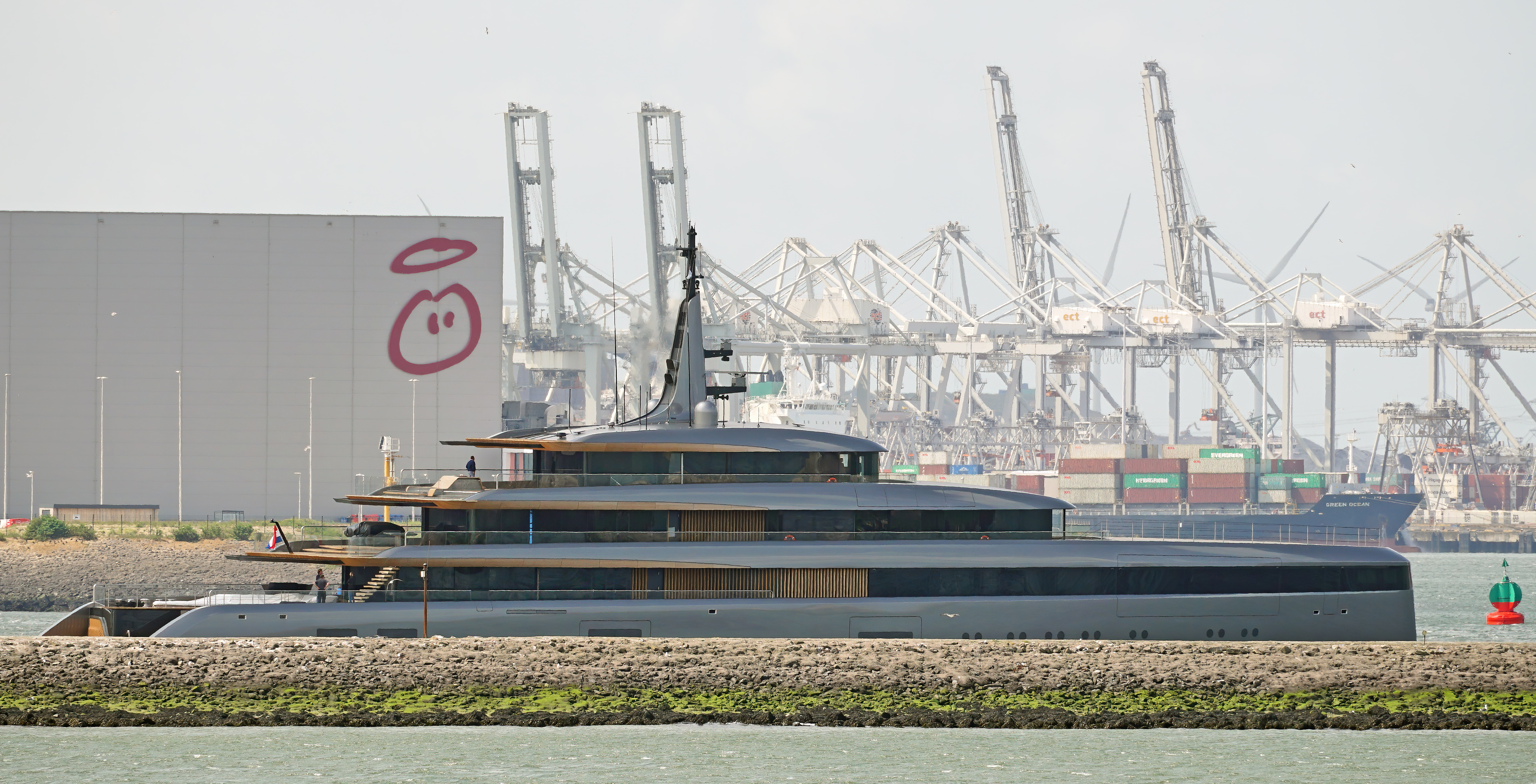
Historical image · Obsidian in Hoek van Holland during sea trials · . This shows her appearance then, not her current condition.
Photo credit & licence
Photo: Kees Torn · OBSIDIAN · CC BY-SA 2.0
Unchanged original JPEG, displayed uncropped. No edits or resizing of the file.
The exact dated Flickr item identifies Obsidian on her 3 July 2023 sea trials. Identity reference. Reviewed .
This photograph records the yacht’s appearance when it was taken.
Photo: Kees Torn · OBSIDIAN · CC BY-SA 2.0. Unchanged original, displayed uncropped.
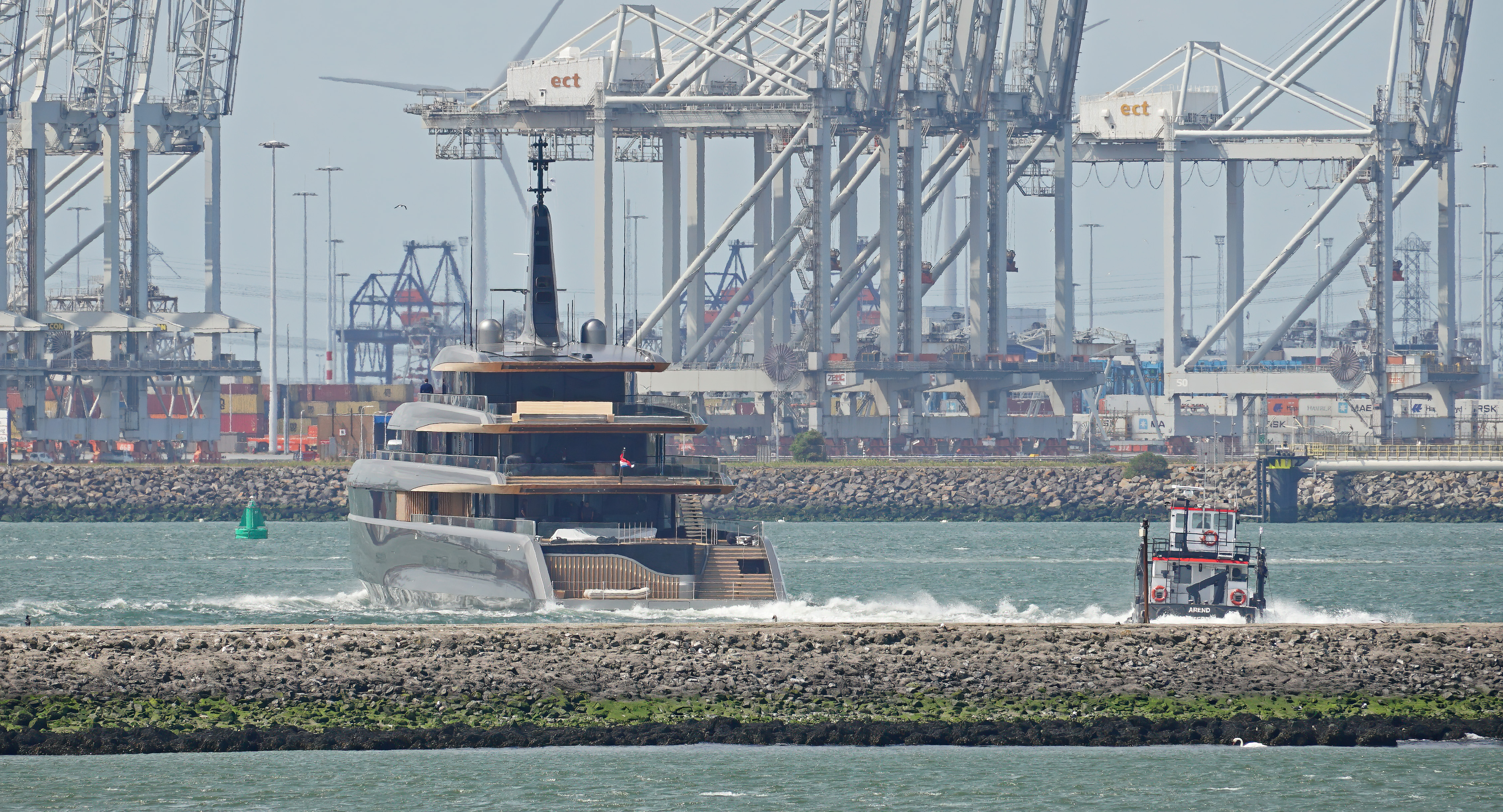
Historical image · Obsidian in Hoek van Holland during sea trials · . This shows her appearance then, not her current condition.
Photo credit & licence
Photo: Kees Torn · OBSIDIAN & AREND · CC BY-SA 2.0
Unchanged original JPEG, displayed uncropped. No edits or resizing of the file.
The exact dated Flickr item identifies Obsidian and Arend. Arend is a separate accompanying pushboat, not an established permanent support vessel. Identity reference. Reviewed .
This photograph records the yacht’s appearance when it was taken.
Photo: Kees Torn · OBSIDIAN & AREND · CC BY-SA 2.0. Unchanged original, displayed uncropped.
Obsidian at a glance
- Guests
- 12–14source-dependentSourceChecked
- Cabins
- 7SourceChecked
- Crew
- 25–27source-dependentSourceChecked
- Cruising speed
- 12 knotsSourceChecked
- Maximum speed
- 17 knotssecondary profileSourceChecked
- Published range
- 5,500 nm at 12 knotsSourceChecked
Capacity depends on the operating arrangement. A cabin count is not a guest limit. See the specifications and range notes.
Four generators, 560 battery modules, twin steerable electric thrusters and an entirely new approach to managing energy at sea.
Obsidian is an 84.2-metre custom Feadship motor yacht delivered in 2023. Developed to improve upon the engineering of Savannah, she combines an optimised steel hull with a substantial diesel-electric propulsion system, 4.5 MWh of battery storage and twin Veth contra-rotating thrusters. Her sophisticated thermal-management systems recover otherwise wasted heat, while electric tenders extend the propulsion philosophy beyond the mothership. The interior includes an underwater Aqua Lounge, panoramic bow observation room and distinctive asymmetrical social spaces.
Settle in for the complete feature →Feature 89 ·
OBSIDIAN: THE 84-METRE SUPERYACHT WITH 560 BATTERIES, NO RUDDERS AND AN ENGINE ROOM THAT CHANGED EVERYTHING
Eight years after Feadship built Savannah, its engineers returned to the drawing board with an extraordinarily ambitious challenge. They wanted to build a larger, more efficient yacht, with four and a half times the electrical storage, a completely different propulsion system and an entirely new approach to heating and cooling. The result can travel 35 nautical miles on batteries alone, has an underwater lounge that doubles as a classroom, and even carries electric tenders. And she's currently putting some considerable ocean mileage beneath those rather unusual propellers.
Friday 27 November 2026 | Feature 89 | Advanced marine engineering, hybrid propulsion and intelligent energy management | Approximately 17–20 minutes for the main feature, followed by the website profile.
In this story
☕ Good morning! Today we're going to investigate a yacht that makes heating the air conditioning sound perfectly sensible.
After yesterday's frustrating interruption, we're back!
And we've got something rather wonderful to investigate.
Imagine walking into the engine room of an enormous 84-metre motor yacht and asking the chief engineer to show you the main propulsion engines.
Except there aren't any conventional main propulsion diesels.
There are four Caterpillar engines, certainly, but none of them is connected mechanically to a propeller shaft running through the hull.
There are no conventional rudders, either.
Instead, there are two steerable electric propulsion units, each capable of delivering two megawatts of power.
And somewhere else within the yacht, in a specially temperature-controlled compartment, there are 560 battery modules.
Collectively, they provide:
4,500 kWh of electrical storage.
That's three times the principal published battery capacity of Wednesday's Seawolf X.
And then things become even more interesting.
The yacht recovers heat from its air-conditioning machinery and uses it to warm the air that the same air-conditioning system has just cooled.
Which sounds like the sort of thing that might happen when two members of our household disagree about the thermostat.
But it is actually an extremely clever solution to the problem of humidity.
The yacht can also extract useful heat from the surrounding seawater.
Her generators are designed to operate at variable speeds.
Her tenders are electric.
And even the conventional anchor arrangement has been reconsidered, freeing up the bow for an extraordinary panoramic observation lounge.
Today's yacht is OBSIDIAN, Feadship hull 710.
And what makes her especially interesting is that she wasn't developed in isolation. She represents the next significant chapter in an engineering programme that began with a yacht we've already featured and rather admired.
Savannah.
The question is whether Feadship has genuinely moved the technology forward.
And judging by the machinery, the answer is rather interesting indeed.
📰 The TL;DR: Why Obsidian matters
- A genuine next-generation Feadship. Delivered in July 2023, with the explicit objective of improving upon Savannah's environmental and engineering performance.
- A 4.5 MWh battery bank. Four and a half times Savannah's original electrical storage capacity, incorporating 560 modules.
- No conventional propeller shaft lines or rudders. Two steerable Veth contra-rotating propulsion units provide thrust and steering.
- A substantial 1,000-volt DC electrical system. A significant development from the 560-volt architecture used aboard Savannah and Lonian.
- Four variable-speed generating sets. Two larger and two smaller Caterpillar installations allow power production to respond more closely to demand.
- A serious investigation of domestic energy consumption. Waste-heat recovery, heat pumps, smarter air conditioning and electrical peak-load management.
- An underwater Aqua Lounge. Alongside an extraordinary bow observation room, low-level dining terrace and unusual asymmetrical interior.
- Real international cruising. Dated observations include Saint Lucia in 2023, Tahiti and Fiji in 2026, and a recent position in the eastern Pacific.
- A wider industry legacy. The environmental assessment work associated with her development helped demonstrate an approach that has now evolved into an international technical specification.
🛥️ Obsidian at a glance
84.2 m
276 ft 3 in overall
2,554 GT
Gross tonnage
4.5 MWh
Battery storage
4,000 kW
Combined propulsion rating
5,500 nm
Published range at 12 knots
35 nm
Published battery-only range
| Specification | Published information |
|---|---|
| Current name | Obsidian |
| Project | Project 710 |
| Builder | Feadship, Royal De Vries |
| Build location | Aalsmeer, Netherlands |
| Yard number | 710 |
| Delivery | July 2023 |
| Naval architecture | Feadship De Voogt Naval Architects |
| Exterior design | RWD / MONK Design |
| Interior design | RWD / MONK Design |
| Length | 84.20 m / approximately 276 ft 3 in |
| Beam | 13.65 m / 44 ft 9 in |
| Draught | 3.75 m / 12 ft 4 in |
| Gross tonnage | 2,554 GT |
| Hull | Steel |
| Superstructure | Aluminium, with carbon-fibre elements |
| Propulsion | Diesel-electric hybrid |
| Main propulsion units | 2 × Veth VL-1550i-CR |
| Propulsion rating | 2 × 2,000 kW |
| Larger generators | 2 × Caterpillar C32B, 1,461 ekW each |
| Smaller generators | 2 × Caterpillar C32 ACERT, 873 ekW each |
| Combined generating capacity | 4,668 ekW |
| Battery modules | 560 |
| Battery capacity | 4,500 kWh |
| DC electrical architecture | 1,000 volts |
| Cruising speed | 12 knots |
| Maximum speed | 17 knots, independently published |
| Conventional operating range | 5,500 nm at 12 knots |
| Battery-only range | 35 nm at 10 knots |
| Battery operation at anchor | 10–15 hours, builder-published |
| Fuel capacity | 255,000 litres |
| Freshwater capacity | 52,400 litres |
| Guest staterooms | 7 |
| Guests | 12–14, source-dependent |
| Crew | 25–27, source-dependent |
| Classification society | Lloyd's Register, reported |
| IMO | 9920605 |
| MMSI | 319266200 |
| Call sign | ZGPH3 |
| Flag | Cayman Islands |
| Permanent shadow vessel | None established |
Sources: the current Feadship fleet specification, YachtBuyer, SuperYacht Times and maritime identification records.
🇳🇱 From Savannah to Obsidian: eight years of engineering progress
To understand why Obsidian exists, we need to revisit Savannah briefly.
When Savannah appeared in 2015, Feadship demonstrated that a very large luxury yacht could integrate conventional marine propulsion with electric machinery and substantial battery storage.
But a successful first-generation engineering project often produces more questions than answers.
Could the batteries be larger?
Could the arrangement of machinery be made more flexible?
Could conventional shafts and rudders be removed?
Could the environmental footprint be reduced without making the yacht considerably smaller?
And, perhaps most importantly, could the designers tackle the energy consumed by the guests themselves?
Obsidian's commissioning brief specifically called for improved efficiency and reduced environmental impact compared with Savannah.
Design work took place during the pandemic, with the challenge of coordinating the specialists responsible for naval architecture, electrical engineering, mechanical systems and interior design.
The completed yacht was delivered in July 2023 following North Sea trials.
What I find particularly interesting is that Savannah didn't become an engineering dead end.
She provided experience from which a different generation of machinery could be developed.
This is exactly why it is worth following the progression of individual shipyards rather than investigating each yacht as though nothing else had previously existed.
Eight years of evolution
| Engineering characteristic | Savannah | Obsidian |
|---|---|---|
| Delivery | 2015 | 2023 |
| Feadship hull number | 686 | 710 |
| Length | 83.50 m | 84.20 m |
| Original battery capacity | Approximately 1,000 kWh | 4,500 kWh |
| DC system | 560 V | 1,000 V |
| Propulsion philosophy | Electro-mechanical hybrid | Fully electric main propulsion |
| Underwater observation | Nemo Lounge | Aqua Lounge |
Obsidian is only 70 centimetres longer, yet her electrical architecture is substantially different.
And the larger battery is only the most obvious part of that development.
🏗️ A hull designed around the speed at which people actually travel
Obsidian's slender forward profile, broad stern and low superstructure. The underwater hull was developed using computer modelling and physical towing-tank testing.
Here's something I've wanted to investigate properly for a while.
Why do yacht designers sometimes concentrate so heavily on maximum speed when the vessel will spend comparatively little time operating at it?
The naval architecture of a vessel involves numerous compromises.
A hull optimised to achieve a particular high maximum speed may not necessarily be the most efficient shape at a substantially lower cruising speed.
And every extra kilowatt needed to propel a hybrid yacht reduces the duration for which it can operate on batteries.
For Obsidian, Feadship and De Voogt concentrated on the hull's behaviour at cruising speed.
The design was investigated through computational fluid dynamics, commonly known as CFD, followed by physical model testing.
What is CFD actually doing?
Instead of immediately building an entire yacht and hoping it behaves as expected, engineers create a digital representation of the proposed hull.
Numerical modelling then helps them understand how water flows around that structure.
They can investigate pressure distribution, wave formation, flow separation and resistance.
They can also examine the flow towards the propellers, which matters enormously for efficiency and vibration.
But computer modelling doesn't make physical testing unnecessary.
A towing tank provides a controlled environment in which a scale model can be pulled through water while resistance and other behaviour are measured.
The results help the naval architects check and refine their predictions.
There are scaling effects to account for, particularly where friction and turbulence are involved. Nevertheless, combining the two methods is considerably more informative than relying on appearance or intuition.
Steel, aluminium and carbon fibre
Obsidian's hull is steel, with aluminium used for the main superstructure.
However, the designers also introduced carbon-fibre structural components, particularly in the aft overhangs.
Those overhangs don't require the usual vertical support pillars.
That is interesting for two reasons.
Firstly, reducing weight in the upper parts of a yacht can benefit stability and reduce the total mass that must be propelled through the water.
Secondly, it allows uninterrupted outdoor spaces without posts obstructing the view.
The carbon fibre is doing an architectural job as well as a structural one.
And the result doesn't look like an experimental research platform.
It looks like a genuinely attractive contemporary superyacht.
Although I suspect designing those large unsupported overhangs was rather more complicated than choosing the deck furniture.
⚙️ THE ENGINE ROOM: Four Caterpillars, but none connected directly to the propellers
Here we go.
This is the department I've been particularly looking forward to.
Feadship's current machinery specification is unusually useful because it provides the actual generator models, electrical power ratings and rotational speeds.
| Generating set | Model | Electrical rating | Rated speed |
|---|---|---|---|
| Large generator 1 | Caterpillar C32B | 1,461 kW | 2,300 RPM |
| Large generator 2 | Caterpillar C32B | 1,461 kW | 2,300 RPM |
| Small generator 1 | Caterpillar C32 ACERT DITTA-SCAC | 873 kW | 2,100 RPM |
| Small generator 2 | Caterpillar C32 ACERT DITTA-SCAC | 873 kW | 2,100 RPM |
| Combined nominal capacity | 4,668 kW |
The published figures are electrical output ratings, rather than merely the engines' mechanical horsepower.
That makes them considerably more useful when considering the electrical architecture.
Why have two different generator sizes?
Imagine that the yacht is sitting at anchor.
Nobody needs four megawatts of propulsion power. But the galley, refrigeration, ventilation, lighting, water systems and numerous other services still need electricity.
Running an unnecessarily large diesel engine at a very low load may be less desirable than using a smaller generating set operating within a more appropriate range.
Then, when the yacht begins a passage, additional generators can be brought into service as demand increases.
The batteries provide another degree of flexibility.
They can absorb energy when generation exceeds demand and provide additional power during periods of higher consumption.
This approach allows the propulsion requirement and the generator operating condition to be managed separately.
The possible generator combinations
- One small generator
- 873 kW
- One large generator
- 1,461 kW
- Both small generators
- 1,746 kW
- One large + one small
- 2,334 kW
- Both large generators
- 2,922 kW
- All four generators
- 4,668 kW
Arithmetic combinations of nominal equipment ratings. Actual dispatch, permissible loading, reserves and redundancy requirements are determined by the vessel's engineering systems and crew.
The use of variable-speed generators and permanent-magnet alternators is a particularly important aspect of the design.
A conventional alternating-current generating arrangement often needs to maintain a particular rotational speed to produce the required electrical frequency.
An architecture using power electronics and a DC distribution system provides opportunities to vary the engine speed while still delivering suitable electrical power through the conversion equipment.
This isn't a guarantee that the engines will always operate at their optimum efficiency.
But it provides the engineers with more control over how they manage them.
And on a vessel with dramatically changing power demands, that flexibility can be valuable.
🌀 No rudders. No conventional shaft lines. So how does she steer?
This is perhaps the most visibly unusual part of Obsidian's engineering.
Her propulsion consists of two:
Veth VL-1550i-CR Integrated L-Drive thrusters.
Each rated at 2,000 kW.
These units incorporate electric motors and steerable propulsion arrangements, removing the need for conventional long mechanical shaft lines passing through the hull.
The propulsion units can direct their thrust in different directions, meaning they also provide the steering function normally performed by rudders.
Two steerable 2,000 kW propulsion units direct thrust and provide steering; each uses contra-rotating propellers.
What does contra-rotating mean?
Each propulsion unit uses two propellers rotating in opposite directions.
A conventional propeller doesn't simply push water backwards. It also imparts some rotational movement to the water flowing past it.
That rotational energy represents an opportunity.
A second propeller, designed to operate in the first propeller's flow, can recover some of that energy and convert it into additional useful thrust.
The exact benefit depends on the design of both propellers, their spacing, operating speed and the surrounding water flow.
This is why Feadship and Veth investigated the shape of the propulsion equipment and its hydrodynamic interaction with the yacht.
The manufacturer currently publishes a model-specific rating of 2,000 kW for the VL-1550i-CR and a nominal propeller-diameter range of 1.8–2.0 metres, approximately six to six and a half feet.
The exact propeller diameters fitted to Obsidian haven't been independently established.
What about manoeuvring?
A conventional vessel's rudders generally rely on water flowing across them to produce steering forces.
Steerable thrusters can direct propulsion force more directly.
That offers considerable flexibility when manoeuvring at low speed.
However, it doesn't automatically establish that the yacht has a particular dynamic-positioning class.
I haven't obtained Obsidian's complete DP or manoeuvring-system specification.
Nor does the presence of two thrusters automatically guarantee that all electrical and cooling services are fully independent.
The physical layout of redundancy matters just as much as the equipment count.
Still, this is a fascinating propulsion arrangement.
And considerably more interesting than simply installing two increasingly enormous diesel engines.
🔋 THE BATTERY DEPARTMENT: 560 modules and 4.5 megawatt-hours
Obsidian's battery bank is housed in a dedicated temperature-controlled compartment towards the middle of the vessel.
The original installation comprises 560 modules.
The total published capacity is 4,500 kWh.
For a boat of this size, that storage capacity provides opportunities that would have been much more difficult with Savannah's original one-megawatt-hour system.
But let's put it in perspective.
How big is 4.5 MWh?
- Obsidian
- 4,500 kWh
- Seawolf X
- 1,500 kWh
- Savannah
- 1,000 kWh
- Energy Observer
- 112 kWh
Nominal capacities from different vessel configurations and publication dates. These are not comparable certified usable-energy measurements.
An ordinary illustrative domestic battery might store 10 kWh.
Obsidian has the nominal equivalent of 450 of those batteries.
But that doesn't mean she could propel herself indefinitely.
Quite the opposite.
At the combined nominal propulsion rating of four megawatts, the two motors alone could theoretically use 4,500 kWh in little more than an hour.
That's before domestic demand, conversion losses or battery operating limits.
An enormous battery still needs an efficient yacht around it.
That is why the hull development and hotel-load engineering are so important.
Why raise the voltage to 1,000 volts?
Savannah and Lonian's earlier systems operated at 560 volts.
Obsidian uses a 1,000-volt DC electrical architecture.
Higher voltage can reduce the current required to transfer a given amount of power.
For example, transferring an illustrative one megawatt:
| DC system voltage | Theoretical current |
|---|---|
| 560 volts | 1,786 amps |
| 1,000 volts | 1,000 amps |
These are simplified calculations using power divided by voltage.
Reducing current can help reduce resistive losses and influence cable size and weight.
Electrical resistive losses increase with the square of current, so the potential benefit is meaningful.
However, a higher-voltage architecture also introduces more demanding insulation, switching, protection and safety requirements.
The system needs to be designed as an integrated whole.
It's a substantial electrical-engineering undertaking, not simply a decision to install bigger batteries.
🌊 What can she actually do using batteries alone?
Feadship's published capability is:
35 nautical miles at 10 knots.
That represents three and a half hours of continuous propulsion.
For a vessel measuring more than 84 metres, I think that is genuinely impressive.
It could be particularly attractive for shorter coastal passages, approaching certain locations or simply enjoying quieter periods of cruising.
At anchor, where the propulsion requirement largely disappears, the published battery-only operating period increases to between ten and fifteen hours.
But those figures don't establish the current usable battery capacity.
Nor do they give us the entire tested power-consumption curve.
Battery age, operating temperature, charge limits and domestic demand all affect actual endurance.
I rather like that the machinery allows a vessel of this size to sit quietly for much of the night without continuously operating its diesel generators.
There will still be pumps, ventilation, refrigeration and other equipment running.
So the word silent should be understood in relation to generator noise, rather than an absolute absence of sound.
But the difference in the experience aboard could be considerable.
Especially when sitting at anchor somewhere beautiful.
❄️ The air conditioning that needs heating
Now we arrive at what may actually be my favourite piece of engineering aboard Obsidian.
Not the batteries.
Not the enormous electric propulsion units.
The air conditioning.
Because Feadship's environmental modelling indicated that approximately 60% of the yacht's energy demand related to operating the accommodation and domestic services, rather than simply propelling the vessel.
That estimate was associated with a standardised operating profile, not a universal measurement for every yacht or every actual passage.
Nevertheless, it reveals why concentrating exclusively on the engine room can overlook a very substantial part of the problem.
The invisible energy demands of luxury
When a yacht is anchored in the Caribbean, the guests expect comfortable accommodation.
The galley is cooking.
The laundry is washing towels.
Swimming pools may need heating.
Freshwater needs producing or distributing.
And the air conditioning is dealing with warm, humid sea air.
Those domestic demands can continue for twenty-four hours a day.
Even while the yacht goes absolutely nowhere.
Why cool air and then warm it again?
Warm air can contain more water vapour than cold air.
If you cool humid air sufficiently, some of that moisture condenses into liquid water, which can be removed.
This is how conventional air-conditioning systems can dehumidify the air.
But the resulting air may be considerably colder than the temperature you actually want inside the cabin.
Feadship describes cooling incoming air to approximately 7°C during this process.
Then it needs to be warmed again to a comfortable temperature.
Traditionally, that reheating can require additional electrical heating.
So you spend energy cooling something down, only to spend more energy warming it up again.
Which does sound slightly ridiculous until you understand the humidity problem.
Obsidian's engineers decided to reuse heat that would otherwise be discarded.
Warm, humid outside air is cooled to around 7°C to remove moisture, then warmed using recovered heat from generators or air-conditioning chillers.
When the diesel generators are operating, they produce substantial waste heat.
The air-conditioning machinery also rejects heat during the refrigeration cycle.
Rather than throwing all that thermal energy away, the yacht can use suitable portions of it for reheating, domestic hot water and other services.
And when those sources aren't sufficient, there is another possibility.
♨️ The surrounding sea becomes a source of heat
Obsidian incorporates heat-pump technology.
A heat pump doesn't necessarily create heat by passing electricity through a heating element.
Instead, it transfers heat from one location to another.
Depending on the operating temperatures and equipment performance, it can deliver several units of useful thermal energy for each unit of electrical energy consumed.
Feadship's engineering description identifies efficiency around five times that of simple resistance heating under the conditions discussed.
That should not be interpreted as a guaranteed coefficient of performance of five in every seawater temperature or operating mode.
Heat-pump efficiency depends on the temperature difference between the available heat source and the required output.
But the principle is extremely attractive.
The yacht can obtain additional thermal energy from seawater when appropriate and select between several sources of heat.
Three different operating situations
| Situation | Published heating strategy |
|---|---|
| In harbour on shore power | Recover heat from air-conditioning equipment; supplement using the heat pump |
| At anchor on batteries | Recover available refrigeration heat; use the heat pump as necessary |
| Generators operating | Make use of recoverable engine heat |
That last arrangement also helps explain why a generator should not always be assessed solely according to its electrical output.
If a substantial portion of its waste heat can be used productively, the overall energy system may gain additional benefits.
Conversely, when the generators are switched off, that source of heat disappears.
The intelligent bit is managing the different systems together.
And I think that's the particularly interesting lesson from this yacht.
⛽ Fuel, water and real ocean-crossing autonomy
Feadship publishes a range of 5,500 nautical miles at twelve knots.
The current yard specification gives:
255,000 litres of fuel.
52,400 litres of freshwater.
Those are useful numbers, and rather more detailed than we obtain for many private vessels.
An alternative published profile gives fuel storage of 240,000 litres and freshwater of 50,000 litres.
The current builder's figures take precedence, although an authenticated tank plan would be required to establish the precise usable volumes.
At twelve knots, travelling 5,500 nautical miles would require approximately nineteen days and two hours of continuous progress.
If the yacht started with the full published fuel volume, several different reserve assumptions would produce the following theoretical maximum average fuel-consumption allowances.
| Illustrative fuel reserve | Fuel available | Average allowance at 12 knots |
|---|---|---|
| 10% | 229,500 L | 501 L/hour |
| 15% | 216,750 L | 473 L/hour |
| 20% | 204,000 L | 445 L/hour |
These are calculations, not measured consumption figures.
They assume the published tank capacity is the starting volume and that the entire voyage takes place at a constant twelve knots.
Feadship does not publish the complete reserve assumptions or actual fuel logs behind the range statement.
We also don't have a confirmed current watermaker production rating.
The figures demonstrate an important distinction between the yacht's two types of endurance.
Her batteries provide useful hours of quieter operation.
Her fuel and generating sets provide the energy necessary for prolonged ocean passages.
And that brings us to another important department.
🌱 HVO: Can you really put vegetable oil into a superyacht?
Not the stuff straight from the chip pan, unfortunately.
Although that would certainly simplify the refuelling arrangements.
HVO stands for hydrotreated vegetable oil.
It is a renewable diesel-type fuel that can be manufactured from various oils and fats through industrial processing.
Suitable waste cooking oils and animal fats can be used as feedstocks.
The resulting fuel can have properties that allow it to be used in compatible diesel engines.
Obsidian's original North Sea trials were conducted using HVO, according to Feadship.
But that doesn't establish which fuel she's carrying on her present voyage.
And there is an important distinction between burning a renewable fuel and producing no exhaust emissions.
Combustion still takes place.
Carbon dioxide still leaves the exhaust.
The potential greenhouse-gas advantage comes primarily from the fuel's lifecycle, including the origin of the carbon, the production process and the energy used to manufacture and transport it.
That means the provenance of the fuel matters enormously.
The UK government's final 2025 renewable transport fuel statistics, published this month, highlight the importance of waste-derived feedstocks in HVO production and the changing availability of these fuels.
The same broad principle applies to superyachts.
You need to know where the fuel came from, how it was produced and whether its sustainability claims are properly substantiated.
It isn't enough to write powered by green fuel underneath a photograph.
📊 What do the environmental claims actually mean?
Feadship has published several different environmental figures associated with Obsidian.
They refer to different things and should not be confused.
None of these should be described as a verified annual fuel saving for Obsidian's actual 2026 operations.
Nor should the percentages be added together.
They use different assessment boundaries.
What we need is a consistent way of examining all these claims.
And here, rather wonderfully, Obsidian's story connects with something that happened earlier this year.
A new international yacht environmental specification
The Water Revolution Foundation's Yacht Environmental Transparency Index, or YETI, was developed to help compare the environmental performance of large yachts.
Instead of judging a yacht simply by its engines or maximum speed, the methodology incorporates a standardised operational pattern and the energy required to operate the vessel.
In March 2026, the International Organization for Standardization published:
ISO/TS 23099:2026.
The technical specification provides a framework for comparing the environmental consequences of operational energy consumption aboard yachts of thirty metres and above.
It incorporates upstream and downstream emissions associated with that energy.
But the published ISO scope explicitly excludes construction and maintenance materials, end-of-life impacts and individual behavioural differences arising from a particular owner's operating choices.
This is important because it tells us what such an assessment can and cannot demonstrate.
A standardised operational comparison is useful.
It is not the same thing as an independently audited lifetime environmental footprint.
Nevertheless, the development is significant.
And Obsidian is a particularly interesting historical example of why the industry began pursuing more consistent approaches to these questions.
🛋️ The interior: Is this actually a school with an underwater classroom?
This yacht has some wonderfully unconventional spaces.
The interior and exterior design involved RWD and MONK Design.
Rather than arranging every corridor and social area in the usual straight lines, the designers introduced extensive asymmetry and unusual orientations.
But several of the most interesting spaces are possible because the engineering arrangements beneath them changed.
The bow observation lounge
Conventional large yachts devote substantial forward deck space to anchoring and mooring machinery.
Obsidian uses a different anchoring arrangement, described by Feadship as submarine-style anchors.
The result frees up room for a panoramic interior observation space at the bow.
There are curved floor-to-ceiling windows overlooking the water ahead.
Access is described as being through the forward tender-garage area from the main-deck accommodation.
I particularly like this.
There is something wonderful about being able to sit comfortably indoors and watch the world approach you.
Especially during a long passage when the weather isn't entirely suitable for sitting outside.
And no, the expression submarine anchors doesn't mean she carries a submarine.
I've checked.
Twice.
😭
The Aqua Lounge
Near the stern, large underwater windows allow occupants to look into the surrounding sea.
The Aqua Lounge is associated with the nearby gym and can also be used for watching films or educational activities.
Imagine learning about marine life, then being able to look directly into the water outside.
That's a wonderful idea.
Of course, what you actually see will depend enormously on the water clarity and location.
A tropical anchorage might provide an extraordinary view.
A muddy industrial harbour may provide a rather less compelling educational experience.
Still, I'd probably spend an unreasonable amount of time in there.
Dining beside the water
Another particularly interesting space is the lower-deck dining saloon.
A large opening provides access to a terrace just 75 centimetres, or approximately 2 ft 6 in, above sea level.
This is remarkably close to the surrounding water for an interior-oriented social space aboard such a large yacht.
The yacht also features a sunken main-deck lounge and concealed access to a study.
Those arrangements are described by the builders, rather than inferred from exterior photography.
Guests and crew
The builder establishes seven staterooms.
Current secondary profiles give fourteen guests and twenty-seven crew, while other sources list twelve guests or twenty-five crew.
The present certified passenger complement and individual cabin assignments haven't been independently confirmed.
And despite all the information available about her unusual public spaces, I haven't obtained a complete approved general arrangement.
We know considerably more about Obsidian's engine room than we do about some parts of her accommodation.
Which, personally, is a research imbalance I can live with.
🚤 The electric tender department
One detail I particularly appreciate is that the propulsion philosophy extends to the smaller boats.
Both principal tenders were originally built by Tenderworks and use electric propulsion.
The yacht was equipped with four fast-charging stations, allowing charging while the tenders are alongside or stored in the garage.
That is an important part of the wider operating system.
Imagine a yacht anchored for several days in a bay.
The mothership may be stationary, but its tenders could make repeated journeys to shore.
If those craft have conventional diesel or petrol engines, their operations contribute to the overall fuel demand.
Electrification changes the way that energy is supplied.
However, charging a tender from the mothership's diesel-generated electricity doesn't automatically eliminate all associated emissions.
It may offer quieter operation and a different efficiency profile, but the ultimate energy source still matters.
| Equipment | Published evidence | Present status |
|---|---|---|
| Electric Tenderworks tenders | Two principal custom craft | Original installation confirmed |
| Fast-charging stations | Four | Original builder specification |
| Tender battery sizes | Not established | Unknown |
| Individual tender names | Not established | Unknown |
| Crewed submarine | None verified | No confirmed resident craft |
| Helicopter | None independently verified | Current inventory unknown |
| Research equipment | No permanent scientific package established | Unknown |
| Permanent support yacht | None established | No verified pairing |
This isn't an equipment-heavy explorer in the same way that Shinkai is.
Obsidian's particular contribution is the energy architecture behind a more conventional luxury-yacht operating model.
🌍 Has she actually travelled anywhere interesting?
Oh, yes.
And today's tracking evidence provides a rather lovely surprise.
December 2023: The Caribbean
A photograph taken by Lyndon Henry on 29 December 2023 documents Obsidian at Rodney Bay, Saint Lucia.
The individual photographic record identifies IMO 9920605.
That's useful evidence of substantial international cruising within months of delivery.
It does not, however, establish which route the yacht took across the Atlantic or how much fuel she consumed.
June 2026: Four extraordinary yachts in Tahiti
Here's a particularly entertaining connection to our imaginary fleet.
On 30 June 2026, SuperYacht Times published a photographic report of four large yachts together off Papeete.
They included:
Octopus
126.2 m | Our floating headquarters
Obsidian
84.2 m | Hybrid-electric engineering
Pi
100 m | Feadship
Odisea
78.2 m | Lürssen
The photograph was reported as having been taken on Wednesday 24 June.
Imagine going for a little wander along the waterfront and discovering that lot sitting offshore.
I'd probably need several cups of tea before I could be persuaded to go home.
Importantly, this is evidence of four vessels sharing an anchorage, not proof of any permanent operational relationship between them.
Neither Pi nor Odisea is being assigned covered status merely because they appear in the same report.
October and November 2026: Fiji and French Polynesia
Recent tracking records establish further activity in Fiji.
A dated position was recorded in the region on 17 October.
Another provider recorded Obsidian at Denarau on 1 November 2026.
Maritime Optima subsequently reports a November visit to Papeete and departure on 13 November at 18:44 UTC, with Panama entered as the destination.
Taken together, those observations establish substantial Pacific cruising.
What they don't establish is a complete circumnavigation.
Nor do they tell us whether any particular section of those voyages was undertaken on battery power alone.
The distinction between the distance travelled and the yacht's measured energy performance remains important.
📍 Where is Obsidian this morning?
The newest precisely timestamped and geolocated AIS observation I located is from Tuesday 24 November.
Eastern Pacific Ocean
24 November 2026, 09:24 UTC
10.8 kn
Reported speed
Latitude
1.9006° N
Longitude
112.4188° W
AIS destination
Panama
Reported ETA
1 December 2026
MagicPort's profile was updated on 26 November and also identifies Panama City as the destination. However, its accessible information does not provide a corresponding precise timestamped coordinate fix.
Therefore, the 24 November observation remains our strongest precise location record.
Her exact location this morning, 27 November, is not independently established.
And the estimated arrival on 1 December remains an estimate, not a confirmed arrival.
👤 Ownership, money and the rather large missing invoice
Current maritime intelligence records identify Ninety Ltd as the registered owner and YCO SAM as the commercial manager.
Those records were checked against the profile updated on 26 November 2026.
The original corporate ownership documents have not been inspected.
Some secondary yacht publications associate the vessel with Czech businessman Karel Komárek, but I haven't found authoritative current documentation establishing the individual beneficial ownership.
I would therefore treat that association as reported, rather than certified.
The financial figures are equally uncertain.
One website gives an estimated price of US$120 million, while another page from the same publisher gives US$180 million.
That is an extraordinary difference.
And neither figure is backed by an authenticated construction contract or completed transaction in the material reviewed.
| Financial question | Established position |
|---|---|
| Original construction cost | Unknown |
| Publicly circulated estimates | US$120m–180m, weakly supported |
| Current public sale asking price | None verified |
| Completed sale transaction | None independently established |
| Current charter tariff | None verified |
| Current individual beneficial owner | Not independently certified |
Y.CO has a public vessel profile, but its presence does not by itself establish that Obsidian is available for charter.
No major completed refit since delivery was established during today's research, either.
That doesn't mean the yacht hasn't undergone maintenance.
It simply means we shouldn't invent a substantial reconstruction programme.
🤔 How does Obsidian compare with our other yachts?
Obsidian versus Savannah
Savannah
2015 | 83.5 m
Obsidian
2023 | 84.2 m
This is the engineering comparison that matters most.
Savannah demonstrated that hybrid propulsion could be successfully incorporated into a major custom superyacht.
Obsidian removes the conventional mechanical connection between the main diesel machinery and the propulsion units.
That changes the possibilities for machinery placement, internal layout and the operation of the electrical system.
The increased battery capacity extends the opportunities for generator-free operation.
But I wouldn't declare Obsidian universally more efficient simply because she has more battery storage.
A properly matched voyage comparison would need to consider the actual energy required to move each yacht and operate its accommodation.
Obsidian versus Seawolf X
Wednesday's Seawolf X takes a similar interest in hybrid propulsion and intelligent energy management but uses a very different hull architecture.
She is a considerably smaller aluminium catamaran.
Obsidian is a steel-hulled monohull with more than five times her gross tonnage.
The smaller yacht's photovoltaic installation is one of her defining features.
Obsidian's published design instead places particularly strong emphasis on waste-heat recovery, variable-speed generation and substantial electrical storage.
A comparison of their battery sizes alone therefore tells us very little about the relative environmental performance.
Both vessels are interesting because their designers sought to reduce demand as well as finding different ways to supply energy.
Obsidian versus Energy Observer
Energy Observer makes particularly extensive use of renewable energy and onboard hydrogen production.
Obsidian does not have a verified hydrogen-production or fuel-cell installation.
She is much more dependent on energy stored in liquid fuel, with electricity providing a flexible means of distributing and storing that energy aboard.
Energy Observer investigates the possibility of operating a relatively small vessel without conventional fuel propulsion.
Obsidian investigates how a much larger luxury yacht can change its energy use without abandoning the comforts expected of that type of vessel.
Different objectives.
Different compromises.
And very different engineering solutions.
☕ Could we live aboard?
Oh, I think so.
There is quite a lot about Obsidian that appeals to me as a potential floating home.
The enormous observation lounge would be lovely during a passage.
The Aqua Lounge could keep everybody entertained when the water was particularly interesting.
And the dining terrace sounds rather wonderful.
However, I'd want to investigate the practical accessibility of the interior.
Some of the sunken spaces, unusual stairs and asymmetrical layouts might create challenges that aren't obvious in the architectural photographs.
We would need proper information about lift access, level changes, doorway widths, bathrooms and safe outdoor circulation.
And we'd need some particularly sensible arrangements for the dogs and cats.
I suspect the cats would immediately claim the bow observation lounge.
The underwater windows would probably keep them entertained for quite some time, although trying to catch fish through several inches of structural glazing might eventually become frustrating.
As for me?
I'd probably be spending far too long in the battery room, asking the engineers how the generator scheduling works.
And then investigating whether the waste-heat recovery system could cope with our laundry requirements.
If the engineers have developed a way of making multiple tumble dryers environmentally respectable, I would very much like to hear about it.
😂
The reality is that an 84-metre yacht with an unusually sophisticated electrical plant and a crew of around twenty-seven requires an enormous operating budget.
But in our imaginary fleet?
Absolutely.
🏆 THE CUPPA VERDICT
All scores are subjective editorial judgements out of ten stars, not certified safety assessments or independently measured performance ratings.
| Department | Cuppa rating |
|---|---|
| Progression from Savannah | |
| Cruise-speed hull optimisation | |
| Veth propulsion engineering | |
| Contra-rotating propellers | |
| Variable-speed generation | |
| 1,000-volt electrical architecture | |
| Battery-storage capacity | |
| Waste-heat recovery | |
| Air-conditioning engineering | |
| Heat-pump integration | |
| Electric tender department | |
| Carbon-fibre overhangs | |
| Underwater Aqua Lounge | |
| Bow observation lounge | |
| Actual Pacific cruising | |
| Published technical documentation | |
| Actual fuel-log transparency | |
| Current ownership transparency | |
| Extreme polar exploration | Not established |
| Submarine department | 😭 |
| Family liveaboard appeal | |
| Would I inspect the thrusters? | Immediately |
| Would I want the electrical drawings? | Every single one |
| Would I investigate the air conditioning? | Surprisingly, yes |
| Would I spend an afternoon in the Aqua Lounge? | Probably several |
| Would I want a copy of the generator logs? | Desperately |
| Does Octopus remain home? | Naturally |
| Would Obsidian join our imaginary fleet? | YES. SHE CAN BE OUR FLOATING ENGINEERING LABORATORY WITH VERY NICE FURNITURE. |
🔧 THE EXTRA: Why the best hybrid yacht might be the one that needs less electricity in the first place
I want to finish with something that has become particularly apparent across the last few features.
We have investigated some extraordinary energy-storage equipment recently.
Hydrogen aboard Energy Observer.
Enormous batteries aboard Seawolf X.
And now the 4.5 MWh installation aboard Obsidian.
But there is another engineering strategy that deserves just as much attention.
Avoiding unnecessary energy demand.
The difference between capacity and consumption
Suppose two yachts both want to spend twelve hours at anchor without running their generators.
The first yacht requires an average electrical supply of 300 kW.
The second requires 250 kW.
That 50 kW difference might not initially sound particularly important for a large vessel.
But over twelve hours it represents 600 kWh of energy.
That's a substantial battery in its own right.
Reducing demand can therefore create additional endurance without installing any more storage.
That's why everything from efficient refrigeration to insulation and heat recovery can matter.
Reducing consumption may be considerably less glamorous than installing hundreds of additional battery modules.
But it can also reduce the weight, cost and space needed for those modules.
Which may produce further benefits elsewhere in the design.
Peak shaving
There's another particularly interesting principle.
A yacht's electricity consumption isn't constant.
A galley may require a substantial amount of power when preparing meals.
Laundry equipment may operate simultaneously.
Pumps and other machinery may start.
And several high-demand systems might briefly create a much greater combined load.
A generating plant designed without suitable storage may need to have additional machinery running simply to accommodate those peaks.
Battery storage provides another option.
It can temporarily supplement the available generation when demand increases, then be recharged when demand falls.
The generators can potentially spend more time operating under favourable conditions.
However, the benefit depends on the actual efficiency curves, battery losses and the number of charging cycles.
The battery isn't supplying free energy.
It is allowing the yacht to manage when energy is produced and consumed.
Reusing heat creates another kind of saving
Electrical energy isn't the only useful form of energy aboard.
Thermal energy is equally important.
When a diesel generator produces electricity, it also rejects considerable heat.
When a refrigeration machine cools an interior, it moves heat somewhere else.
If the yacht simultaneously needs hot water or warm air, some of that rejected heat may be useful.
A carefully integrated thermal system can therefore avoid consuming additional electricity to create heat that was already available.
It's a beautifully logical idea.
And something that can potentially be applied well beyond enormous private yachts.
The next step: measuring the whole system
The most useful future publication from Feadship would be a properly documented operating study of Obsidian.
I'd love to see actual monthly fuel consumption, shore-power use, battery charging cycles, propulsion demand and recovered thermal energy.
It would be particularly interesting to compare different cruising climates.
How does the electrical demand change between the Mediterranean, the Caribbean and the Pacific?
How often does the heat pump operate?
What proportion of recovered heat is actually useful?
How much of the yacht's cruising time is spent in battery-only mode?
And what happens to battery performance after several years of service?
Those are the sorts of questions that would turn an excellent new-build technical story into an even more valuable long-term engineering dossier.
Because the most impressive yacht isn't necessarily the one that can carry the most energy. It may be the one that can do the most with the energy it already has.
☕ Final thoughts
I think Obsidian represents a particularly interesting moment in the development of the modern superyacht.
She isn't an experimental vessel that has sacrificed most of its accommodation to carry research equipment.
She isn't a demonstration boat making carefully selected short trips.
She's an actual 84-metre private yacht that has travelled substantial distances, including genuine Pacific cruising.
And beneath her rather attractive exterior is an engineering system that challenges several conventional approaches to yacht design.
Four diesel engines producing electricity rather than directly driving propellers.
Steerable contra-rotating propulsion.
Hundreds of battery modules.
An electrical distribution system operating at a thousand volts.
Air-conditioning equipment that contributes useful heat to other systems.
And tenders that plug in rather than requiring conventional refuelling.
I particularly like that the project developed from what Feadship learnt with Savannah.
The technology didn't stand still.
And the designers didn't simply increase the capacity of everything.
They reconsidered the relationships between machinery, structure, interior design and the way people actually use a yacht.
We still need more independent evidence of her long-term operating efficiency.
But the engineering achievement is substantial.
And somewhere in the Pacific, those rather unusual propellers have been putting it to work.
Obsidian. Eighty-four metres of Dutch engineering, 560 battery modules, four Caterpillars, two extraordinary propulsion units and an air-conditioning system that may finally have made me interested in air conditioning.
Rather magnificent.
And certainly worth the wait after yesterday's missing edition.
☕🛥️🔋⚡🌊❤️
📸 Photographs, copyright and permissions
Rights checked: 27 November 2026.
Today's vessel has a particularly good official photographic collection.
Unfortunately, availability is not the same as permission.
Feadship's website legal notice explicitly requires prior written permission for public or commercial use of its protected material. Its press gallery contains downloadable photographs, including technical interiors, but I have not established a separate licence overriding those restrictions for SYWMC.
🔎 Best primary and independent sources
| Source | Why it's worth reading |
|---|---|
| Feadship: Obsidian fleet profile | Primary machinery, dimensions, tankage and range |
| Feadship: July 2023 delivery and engineering report | Detailed explanation of the original engineering programme and technical photographic collection |
| Feadship: October 2023 engineering retrospective | Waste-heat recovery, batteries and operating philosophy |
| Veth Integrated L-Drive | First-party propulsion model specifications |
| Twin Disc: Contra-rotating yacht propulsion | Understanding the manufacturer's engineering approach |
| Feadship: Savannah | Original hybrid programme and direct engineering comparison |
| Quantum XT stabilisers | Manufacturer explanation of the stabilisation technology reported aboard Obsidian |
| SuperyachtNews: Delivery report | Independent industry coverage and stabilisation detail |
| Megayacht News: Original owner directive | Independent coverage of the environmental engineering brief |
| Water Revolution Foundation: YETI | Operational environmental assessment methodology |
| ISO/TS 23099:2026 | Important current international technical specification and its scope |
| Y.CO: Obsidian | Management-associated vessel description |
| YachtBuyer: Detailed specifications | Independent dimensions and accommodation |
| Shipspotting: Saint Lucia observation | Dated December 2023 photographic evidence |
| Wingo Marine: AIS | Latest precise November position located |
| MagicPort: IMO 9920605 | Current registry-derived ownership and management |
| Feadship legal notice | Important photographic and content-permission restrictions |
The details, properly labelled.
Figures stay with their source and review date. Sizes are shown in feet and inches, then metres. Conversions are rounded to the nearest inch.
- Guests
- 12–14(source-dependent)Source Checked
- Cabins
- 7Source Checked
- Crew
- 25–27(source-dependent)Source Checked
- Beam
- 44 ft 9 in(13.65 m)Source Checked
Build & dimensions
Engineering
- Propulsion
- Diesel-electric hybridSource Checked
- Engine count
- 4 generating setsSource Checked
- Engine make / model
- Caterpillar C32B / C32 ACERTSource Checked
- Engine power
- 2 × 2,000 kW electric propulsionSource Checked
- Cruising speed
- 12 knotsSource Checked
- Top speed
- 17 knots(secondary profile)Source Checked
- Range
- 5,500 nm at 12 knotsSource Checked
Details still to confirm2 specifications
Some sources disagree; other details have not been established. The status of each field is shown below.
- Last major refit
- Not yet known
- Engine displacement
- Not yet known
In this story
From Savannah to Obsidian
When Savannah appeared in 2015, Feadship demonstrated that a very large luxury yacht could integrate conventional marine propulsion with electric machinery and substantial battery storage.
Obsidian's commissioning brief specifically called for improved efficiency and reduced environmental impact compared with Savannah.
Feadship’s engineering account. Checked 27 November 2026.
Build and identity
| Field | Value |
|---|---|
| Name | Obsidian |
| Project name | Project 710 |
| Hull number | 710 |
| Builder | Feadship |
| Yard | Royal De Vries, Aalsmeer |
| Delivery | July 2023 |
| Exterior and interior | RWD / MONK Design |
| Naval architect | Feadship De Voogt |
| Length | 84.20 m / approximately 276 ft 3 in |
| Beam | 13.65 m / 44 ft 9 in |
| Draught | 3.75 m / approximately 12 ft 4 in |
| GT | 2,554 |
| Hull | Steel |
| Superstructure | Aluminium |
| Additional construction | Carbon-fibre aft overhangs |
| IMO | 9920605 |
| MMSI | 319266200 |
| Call sign | ZGPH3 |
| Flag | Cayman Islands |
| Classification society | Lloyd's Register, reported |
| Exact current class notation | Not independently established |
| Ice class | Not established |
Feadship’s fleet record. Checked 27 November 2026.
Hull and naval architecture
For Obsidian, Feadship and De Voogt concentrated on the hull's behaviour at cruising speed.
The design was investigated through computational fluid dynamics, commonly known as CFD, followed by physical model testing.
Obsidian's hull is steel, with aluminium used for the main superstructure.
However, the designers also introduced carbon-fibre structural components, particularly in the aft overhangs.
Those overhangs don't require the usual vertical support pillars.
Feadship’s fleet record. Checked 27 November 2026.
Machinery and propulsion
| System | Specification | Evidence status |
|---|---|---|
| Propulsion | Diesel-electric hybrid | Builder |
| Thruster manufacturer | Veth | Builder |
| Thruster model | VL-1550i-CR | Builder |
| Thruster count | 2 | Builder |
| Rating per unit | 2,000 kW | Builder |
| Rated speed | 750 RPM | Builder |
| Total rated propulsion power | 4,000 kW | Calculated |
| Propeller arrangement | Contra-rotating | Builder |
| Conventional rudders | None | Builder |
| Conventional long shaft lines | None | Builder |
| Model propeller-diameter range | 1.8–2.0 m | Manufacturer, not confirmed installed measurement |
| Larger generating sets | 2 × Cat C32B | Builder |
| Larger set rating | 1,461 ekW each | Builder |
| Smaller generating sets | 2 × Cat C32 ACERT DITTA-SCAC | Builder |
| Smaller set rating | 873 ekW each | Builder |
| Total nominal generation | 4,668 ekW | Calculated |
| Generator operation | Variable-speed | Original engineering |
| Alternators | Permanent-magnet type | Original engineering |
| Emergency generator | Rating unverified | Unknown |
| Stabilisation | Quantum XT extendable fins reported | Current installation certificate uninspected |
| DP notation | Not independently established | Unknown |
Sources: Feadship’s fleet record. Checked 27 November 2026. Veth Integrated L-Drive and SuperyachtNews.
Generating plant
The published figures are electrical output ratings, rather than merely the engines' mechanical horsepower.
Explore the generator output chart in the complete feature.
The use of variable-speed generators and permanent-magnet alternators is a particularly important aspect of the design.
Feadship’s fleet record. Checked 27 November 2026.
Veth propulsion
Her propulsion consists of two:
Veth VL-1550i-CR Integrated L-Drive thrusters.
Each rated at 2,000 kW.
See the conceptual Veth propulsion diagram.
The exact propeller diameters fitted to Obsidian haven't been independently established.
Battery storage
Obsidian's battery bank is housed in a dedicated temperature-controlled compartment towards the middle of the vessel.
The original installation comprises 560 modules.
The total published capacity is 4,500 kWh.
Compare the published nominal battery capacities.
Feadship’s engineering account. Checked 27 November 2026.
High-voltage distribution
| System | Published specification |
|---|---|
| Nominal battery capacity | 4,500 kWh |
| Battery modules | 560 |
| Distribution architecture | 1,000 V DC |
| Battery compartment | Temperature-controlled, amidships |
| Current usable battery capacity | Not independently measured |
| Current battery state of health | Not published |
| Solar-generation system | No substantial installation established |
| Hydrogen fuel cell | None verified |
| Heat recovery | Generator and refrigeration waste heat |
| Heat pumps | Seawater heat-source capability |
| HVAC control | Computerised zonal management |
| Electrical peak shaving | Original design feature |
| Propulsion battery endurance | 35 nm at 10 knots, published |
| At-anchor battery operation | 10–15 hours, published |
Higher voltage can reduce the current required to transfer a given amount of power.
However, a higher-voltage architecture also introduces more demanding insulation, switching, protection and safety requirements.
Feadship’s engineering account. Checked 27 November 2026.
Heat recovery
Rather than throwing all that thermal energy away, the yacht can use suitable portions of it for reheating, domestic hot water and other services.
See the conceptual heat-recovery diagram.
Feadship’s engineering account. Checked 27 November 2026.
Heat pumps, HVAC and using less energy
Feadship's engineering description identifies efficiency around five times that of simple resistance heating under the conditions discussed.
That should not be interpreted as a guaranteed coefficient of performance of five in every seawater temperature or operating mode.
Heat-pump efficiency depends on the temperature difference between the available heat source and the required output.
Use the energy-saving calculator in The Extra.
Feadship’s engineering account. Checked 27 November 2026.
Battery endurance
Feadship's published capability is:
35 nautical miles at 10 knots.
At anchor, where the propulsion requirement largely disappears, the published battery-only operating period increases to between ten and fifteen hours.
But those figures don't establish the current usable battery capacity.
Use the battery endurance calculator and anchor preset.
Fuel, range and autonomy
| Parameter | Published value |
|---|---|
| Cruising speed | 12 knots |
| Maximum speed | 17 knots |
| Conventional operating range | 5,500 nm at 12 knots |
| Battery-only range | 35 nm at 10 knots |
| Fuel capacity | 255,000 litres |
| Alternative fuel figure | 240,000 litres |
| Freshwater capacity | 52,400 litres |
| Alternative freshwater figure | 50,000 litres |
| Fuel compatibility | Conventional diesel and HVO |
| HVO demonstrated | Builder reports use during 2023 trials |
| Present fuel type | Unknown |
| Verified range reserve | Not established |
| Actual current fuel consumption | Not published |
| Watermaker output | Unknown |
| Current measured hotel loads | Unknown |
The current builder's figures take precedence, although an authenticated tank plan would be required to establish the precise usable volumes.
Her batteries provide useful hours of quieter operation.
Her fuel and generating sets provide the energy necessary for prolonged ocean passages.
Feadship’s fleet record. Checked 27 November 2026.
HVO fuel
HVO stands for hydrotreated vegetable oil.
Obsidian's original North Sea trials were conducted using HVO, according to Feadship.
But that doesn't establish which fuel she's carrying on her present voyage.
And there is an important distinction between burning a renewable fuel and producing no exhaust emissions.
Combustion still takes place.
Carbon dioxide still leaves the exhaust.
The potential greenhouse-gas advantage comes primarily from the fuel's lifecycle, including the origin of the carbon, the production process and the energy used to manufacture and transport it.
Feadship’s engineering account. Checked 27 November 2026.
Environmental assessment
Read the separate 27%, 60% and 90% environmental claims and their qualifications.
None of these should be described as a verified annual fuel saving for Obsidian's actual 2026 operations.
Nor should the percentages be added together.
They use different assessment boundaries.
The technical specification provides a framework for comparing the environmental consequences of operational energy consumption aboard yachts of thirty metres and above.
But the published ISO scope explicitly excludes construction and maintenance materials, end-of-life impacts and individual behavioural differences arising from a particular owner's operating choices.
ISO/TS 23099:2026 and Water Revolution Foundation’s YETI methodology.
Find your way around.
| Area | Documented features |
|---|---|
| Forward observation lounge | Curved floor-to-ceiling windows |
| Main deck | Guest accommodation, sunken lounge and access towards forward tender area |
| Lower dining saloon | Opening wall and low-level external terrace |
| Dining terrace height | Approximately 0.75 m above the water |
| Aqua Lounge | Below-waterline viewing windows; cinema and classroom functions described |
| Gym | Associated with Aqua Lounge area |
| Stern | Asymmetrical outdoor arrangement |
| Aft overhangs | Carbon-fibre construction without conventional pillars |
| Guest staterooms | 7 |
| Guests | 12–14 depending on source |
| Crew | 25–27 depending on source |
| Crew cabins | 14, secondary specification |
| Engine room | Single-level arrangement |
| Battery room | Dedicated amidships compartment |
No complete approved general arrangement has been obtained.
The present certified passenger complement and individual cabin assignments haven't been independently confirmed.
Feadship’s fleet record. Checked 27 November 2026.
The underwater Aqua Lounge
Near the stern, large underwater windows allow occupants to look into the surrounding sea.
The Aqua Lounge is associated with the nearby gym and can also be used for watching films or educational activities.
Of course, what you actually see will depend enormously on the water clarity and location.
A tropical anchorage might provide an extraordinary view.
A muddy industrial harbour may provide a rather less compelling educational experience.
Feadship’s engineering account. Checked 27 November 2026.
A small fleet of her own.
| Equipment | Specification | Status |
|---|---|---|
| Tenderworks electric tenders | Two custom principal craft | Original documented installation |
| Fast-charging stations | Four | Builder |
| Tender names | Unknown | Not established |
| Tender dimensions | Unknown | Not established |
| Tender motor ratings | Unknown | Not established |
| Underwater viewing windows | Aqua Lounge | Documented |
| Submarine-style anchors | Original design | Documented |
| Resident submarine | None established | Unknown |
| Helicopter | None verified | Unknown |
| Scientific laboratory inventory | None established | Unknown |
| Permanent shadow yacht | None established | None |
Equipment checked 27 November 2026. The principal tender installation dates from the original 2023 specification. Continued physical presence of every original item has not been independently inspected.
However, charging a tender from the mothership's diesel-generated electricity doesn't automatically eliminate all associated emissions.
Feadship’s fleet record. Checked 27 November 2026.
Real voyages
A photograph taken by Lyndon Henry on 29 December 2023 documents Obsidian at Rodney Bay, Saint Lucia.
On 30 June 2026, SuperYacht Times published a photographic report of four large yachts together off Papeete.
The photograph was reported as having been taken on Wednesday 24 June.
Importantly, this is evidence of four vessels sharing an anchorage, not proof of any permanent operational relationship between them.
Recent tracking records establish further activity in Fiji.
A dated position was recorded in the region on 17 October.
Another provider recorded Obsidian at Denarau on 1 November 2026.
Maritime Optima subsequently reports a November visit to Papeete and departure on 13 November at 18:44 UTC, with Panama entered as the destination.
Nor do they tell us whether any particular section of those voyages was undertaken on battery power alone.
Saint Lucia’s dated photographic record. The complete feature below preserves the detailed account and qualifications.
Ownership, charter and money
| Field | Position |
|---|---|
| Reported registered owner | Ninety Ltd |
| Reported commercial manager | YCO SAM |
| Individual owner association | Karel Komárek, secondary reporting only |
| Verified beneficial ownership | Not established |
| Original construction cost | Unknown |
| Current asking price | None verified |
| Completed transaction | None verified |
| Historical media estimates | US$120m–180m, weak evidence |
| Present market valuation | Unknown |
| Current commercial charter tariff | None verified |
| Charter availability | Not established |
| Major completed post-delivery refit | None independently established |
Checked: 27 November 2026.
The original corporate ownership documents have not been inspected.
No authenticated current valuation, sale price, construction invoice or charter tariff has been established.
Y.CO has a public vessel profile, but its presence does not by itself establish that Obsidian is available for charter.
Registry-derived maritime profile and Y.CO.
A week aboard.
Not yet known
No sourced charter rate is recorded here.
What is she worth?
Not yet known
No sourced valuation is recorded here. Charter rates and sale values are different things.
Any valuation here will name its date and source.
Dated Pacific locations
Explore all four dated Pacific locations in the offline schematic.
Her exact location this morning, 27 November, is not independently established.
And the estimated arrival on 1 December remains an estimate, not a confirmed arrival.
Related yachts
| Yacht | Why it is related |
|---|---|
| Savannah | Direct technological predecessor, early Feadship hybrid architecture |
| Lonian | Intermediate development of Feadship's electrical systems |
| Seawolf X | Hybrid-electric luxury yacht with different hull architecture |
| Energy Observer | Alternative approach to renewable energy and storage |
| Breakthrough | Later Feadship programme incorporating hydrogen fuel-cell technology |
| Octopus | Contrasting equipment-focused expedition philosophy |
Explore Octopus and Lonian, or explore Savannah’s complete feature and website profile and Seawolf X.
Explore Shinkai and Energy Observer.
Read the companion feature on Pi, Feadship hull 824.
Read the companion feature on Odisea, formerly ACE 21.
The complete morning feature
Photographs and rights
The exterior photograph carries its exact source, photographer and reuse licence beside the image.
The original article’s reference photographs remain private. The editorial charts and conceptual diagrams on this page are supplied reconstructions.
Sources and contradictions
| Issue | Disagreement | Editorial treatment |
|---|---|---|
| Length | 84.2 m versus rounded AIS 85 m | Prefer builder |
| Beam | 13.60–13.66 m | Prefer builder's 13.65 m |
| Draught | 3.75 m versus AIS 4.0 m | Different measurement bases |
| GT | 2,554 versus isolated 2,555 | Prefer consistently corroborated 2,554 |
| Engine output | Some secondary horsepower values inconsistent with kW | Use builder's 2,000 kW per thruster |
| Fuel tankage | 240,000 versus 255,000 L | Prefer current builder |
| Freshwater | 50,000 versus 52,400 L | Prefer current builder |
| Guest complement | 12 versus 14 | Current certification needed |
| Crew | 25 versus 27 | Current roster unknown |
| Environmental savings | 27%, 60% and 90% | Different scopes, not interchangeable |
| Battery range | Manufacturer performance versus actual passage records | Keep separate |
| Current fuel type | HVO-capable versus actual fuel aboard | Current fuel unverified |
| Ownership | Corporate register versus secondary individual association | Preserve distinction |
| Estimated value | US$120m versus US$180m | Neither authenticated |
| Current position | Dated coordinates versus newer incomplete AIS descriptions | Prefer absolute timestamped observation |
🔎 Best primary and independent sources
| Source | Why it's worth reading |
|---|---|
| Feadship: Obsidian fleet profile | Primary machinery, dimensions, tankage and range |
| Feadship: July 2023 delivery and engineering report | Detailed explanation of the original engineering programme and technical photographic collection |
| Feadship: October 2023 engineering retrospective | Waste-heat recovery, batteries and operating philosophy |
| Veth Integrated L-Drive | First-party propulsion model specifications |
| Twin Disc: Contra-rotating yacht propulsion | Understanding the manufacturer's engineering approach |
| Feadship: Savannah | Original hybrid programme and direct engineering comparison |
| Quantum XT stabilisers | Manufacturer explanation of the stabilisation technology reported aboard Obsidian |
| SuperyachtNews: Delivery report | Independent industry coverage and stabilisation detail |
| Megayacht News: Original owner directive | Independent coverage of the environmental engineering brief |
| Water Revolution Foundation: YETI | Operational environmental assessment methodology |
| ISO/TS 23099:2026 | Important current international technical specification and its scope |
| Y.CO: Obsidian | Management-associated vessel description |
| YachtBuyer: Detailed specifications | Independent dimensions and accommodation |
| Shipspotting: Saint Lucia observation | Dated December 2023 photographic evidence |
| Wingo Marine: AIS | Latest precise November position located |
| MagicPort: IMO 9920605 | Current registry-derived ownership and management |
| Feadship legal notice | Important photographic and content-permission restrictions |
A little further down the rabbit hole.
| Source | What to watch for |
|---|---|
| Feadship | Updated technical details and refit information |
| Y.CO | Management-associated vessel information |
| Veth | Propulsion technology developments |
| Water Revolution Foundation | Updated environmental methodologies |
| IMO-linked maritime profile | Changes in management and registration |