
Feature 56 · Friday 23 October 2026
Savannah
Hybrid propulsion and a cinema whose best picture is outside the window.
- Length
- 273 ft 11 in83.50 mBuilder’s source
- Delivered
- 2015July 2015Builder’s source
Research & acknowledgements
Independent research compiled with AI assistance from publicly available sources; no direct assistance is recorded. Figures and observations retain the 23 October 2026 research date.
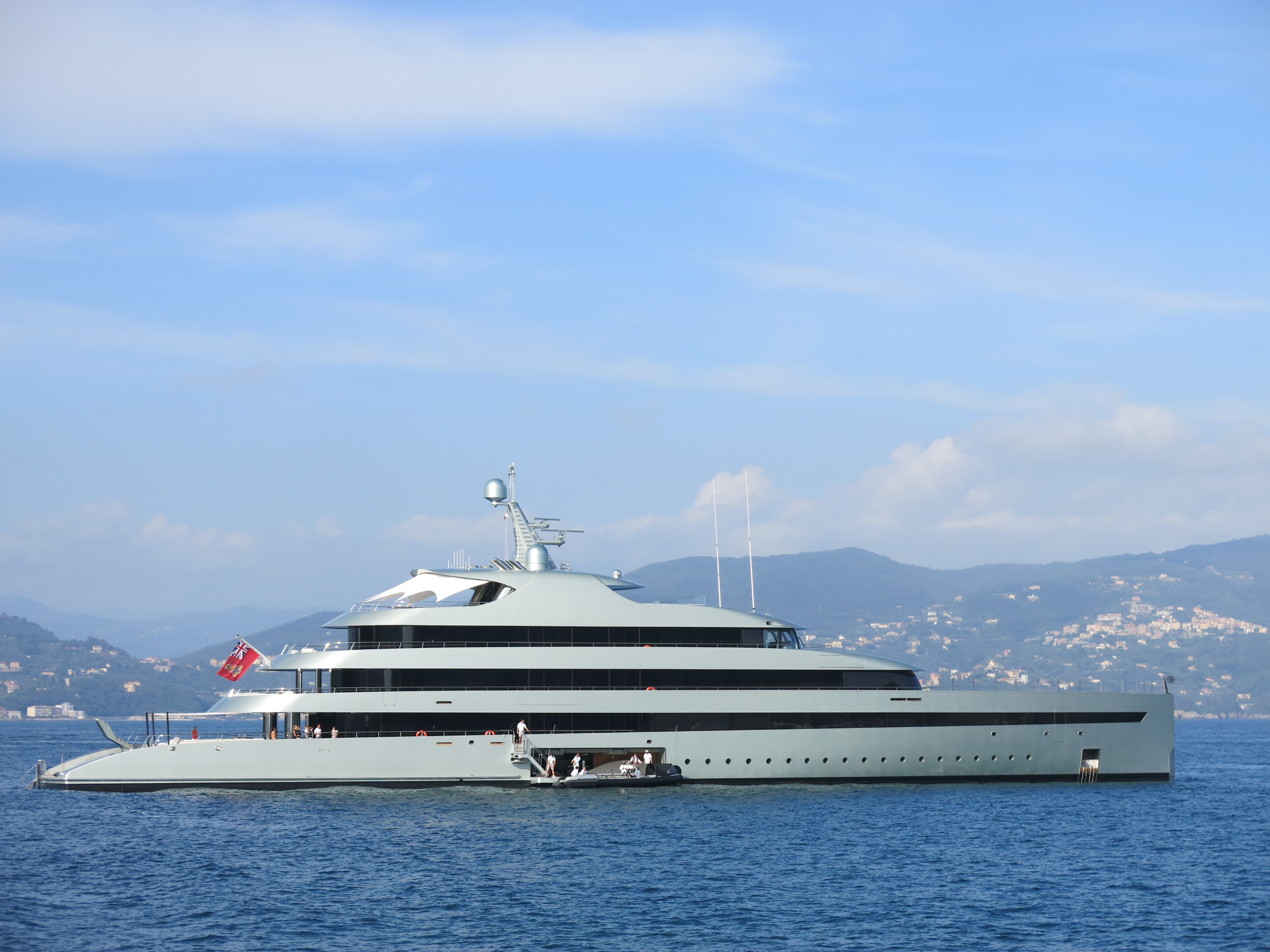
Historical image · Savannah in the Gulf of La Spezia, Italy · . This shows her appearance then, not her current condition.
Photo credit & licence
Photo: Tangopaso · Large yacht Savannah in the gulf of La Spezia · Public domain
Unchanged original JPEG, displayed uncropped. No edits or resizing of the file.
The photographer identifies Savannah in La Spezia in June 2016. The file description and camera record differ by one day, so only the month is shown. Identity reference. Reviewed .
This photograph records the yacht’s appearance when it was taken.
Photo: Tangopaso · Large yacht Savannah in the gulf of La Spezia · Public domain. Unchanged original, displayed uncropped.
Savannah at a glance
- Guests
- 12SourceChecked
- Cabins
- 6SourceChecked
- Crew
- 24–26source-dependentSourceChecked
- Cruising speed
- 12–14 knotssource-dependentSourceChecked
- Maximum speed
- 17–18 knotssource-dependentSourceChecked
- Published range
- 6,500 nm at 12 knotsSourceChecked
Capacity depends on the operating arrangement. A cabin count is not a guest limit. See the specifications and range notes.
Hybrid propulsion and a cinema whose best picture is outside the window.
Savannah combined a single large diesel, electric generators, lithium-ion batteries, an enormous central propeller and an electrically driven azimuthing thruster.
Settle in for the complete feature →Feature 56 ·
☕ Superyacht With My Cuppa: SAVANNAH
The extraordinary 83.5-metre Feadship with a semi-submerged underwater cinema, a 1,000 kWh battery system, an enormous swimming pool, a helicopter deck and a propulsion system that helped change how superyachts are engineered. Oh, and you've probably seen her in a Netflix thriller!
Friday, 23 October 2026 | A 9–10-minute morning read
In this story
OH, THIS IS A LOVELY ONE.
And today's yacht has something I've been wanting to find for ages.
Not a submarine, unfortunately.
Although we're getting surprisingly close.
Because today's yacht has an actual:
UNDERWATER OBSERVATION LOUNGE.
With enormous windows looking directly into the sea.
And another window looking into the yacht's swimming pool.
And if watching fish swim past gets boring, you can lower a cinema screen and watch a film instead.
Which seems almost criminal.
Imagine sitting in a beautiful lounge, somewhere in the Caribbean, watching tropical fish through enormous underwater windows.
Perhaps a turtle wanders past.
Perhaps a ray.
Perhaps an enormous shoal of fish.
And somebody says:
"Shall we put Netflix on?"
ABSOLUTELY NOT. WE HAVE AN ACTUAL OCEAN OUTSIDE!
😂
But there's much more to SAVANNAH than her extraordinary underwater room.
Because when Feadship delivered her in 2015, she represented a genuinely important development in superyacht engineering.
Instead of the conventional arrangement of two enormous diesel engines driving two propellers, Savannah combined a single large diesel, electric generators, lithium-ion batteries, an enormous central propeller and an electrically driven azimuthing thruster.
The builders claimed the arrangement could save approximately 30% of fuel compared with conventional superyachts of similar size.
And eleven years later, the engineering remains fascinating. Feadship launch specifications · Lloyd’s Register
But there's another reason today's yacht deserves our attention.
In May 2025, she was sold after being advertised for €140 million.
She has also become a genuine film star.
And this morning, we have a properly dated AIS position showing her in the Atlantic, travelling west.
So she's still doing some serious passage-making.
Excellent.
🛥️ SAVANNAH AT A GLANCE
| Column 1 | SAVANNAH |
|---|---|
| Builder | Feadship, Koninklijke De Vries |
| Shipyard | Aalsmeer, Netherlands |
| Hull number | 686 |
| Launched | January 2015 |
| Delivered | July 2015 |
| Length | 83.50 m / 273 ft 11 in |
| Beam, builder specification | 12.20 m / 40 ft |
| Alternative published beam | 12.50 m / 41 ft |
| Draught, builder specification | 3.85 m / 12 ft 7 in |
| Alternative published draught | 3.95 m / approximately 13 ft |
| Gross tonnage | 2,305 GT |
| Hull | Steel |
| Superstructure | Aluminium |
| Naval architecture | Feadship De Voogt |
| Exterior design | Studio De Voogt and CG Design |
| Interior design | CG Design |
| Main engine | 1 × Wärtsilä 9L20 |
| Main-engine power | 1,800 kW / approximately 2,414 hp |
| Generators | 1 × Caterpillar C32, 2 × Caterpillar C18 |
| Generator ratings | 830 kW + 450 kW + 450 kW |
| Battery system | Approximately 1,000 kWh lithium-ion |
| Main propulsion | Single variable-pitch propeller |
| Additional propulsion | Electrically driven azimuthing stern thruster |
| Cruising speed | Approximately 12–14 knots |
| Maximum speed | Approximately 17–18 knots |
| Published range | 6,500 nautical miles |
| Fuel capacity, builder | 171,470 litres |
| Fresh water, builder | 33,580 litres |
| Guests | 12 |
| Guest cabins | 6 |
| Crew | Approximately 24–26 |
| Swimming pool | 9 metres long |
| Underwater lounge | Yes, Nemo Lounge |
| Helicopter landing area | Touch-and-go facility documented |
| Submarine | None confirmed |
| Dedicated support vessel | None documented |
| Documented major maintenance | 2020–2022 |
| Additional published refit year | 2024 |
| Last asking price | €140 million |
| Sale confirmed | 13 May 2025 |
The original measurements and machinery come from Feadship. More recent brokerage records give slightly greater beam and draught, and larger freshwater tankage. Without final measurement and tank-calibration documents, those differences remain unresolved. The 2,305 GT figure is supported by recent brokerage and maritime records. Feadship: SAVANNAH, hull 686, Northrop & Johnson: SAVANNAH technical sales inventory
And just look at the machinery arrangement.
One main diesel engine.
On an 83.5-metre, 2,305 GT superyacht.
That's unusual.
Very unusual.
And it's where today's engineering story begins.
⚡ THE FIRST OF A DIFFERENT KIND OF HYBRID
Now, this is worth understanding properly.
Because the word hybrid gets used rather loosely.
Some yachts are described as hybrid because their generators can charge batteries.
Others use electrical power for hotel systems.
And some genuinely have multiple ways of driving their propellers.
Savannah belongs firmly in that last category.
Feadship described her as the world's first hybrid superyacht when she launched.
More precisely, she was the first superyacht to combine this particular diesel, diesel-electric and fully electric propulsion architecture.
Lloyd's Register confirmed the engineering innovation in March 2015. Lloyd's Register: Feadship launches hybrid superyacht, March 2015
Here's how it works.
Savannah's main diesel is a:
WÄRTSILÄ 9L20.
A nine-cylinder, medium-speed marine diesel.
Producing approximately:
1,800 kW AT 1,000 RPM.
This is very different from the high-revving marine diesels fitted to many conventional luxury yachts.
The central propulsion arrangement uses a large controllable-pitch propeller.
But that's only part of the story.
Behind it sits a separate:
AZIMUTHING ELECTRIC THRUSTER.
And that is where things become particularly clever.
🌀 TWO PROPELLERS WORKING TOGETHER
Imagine a large central propeller pushing water backwards.
That's how it produces thrust.
But the water emerging behind a propeller doesn't necessarily move in a perfectly straight line.
Some of it is rotating.
And rotational energy in the wake represents energy that isn't contributing directly to forward movement.
Savannah's designers positioned an electrically powered, azimuthing propulsor behind the main propeller.
This arrangement allows the second propulsion unit to recover some useful energy from the flow while providing additional thrust.
Lloyd's Register describes the arrangement as a combination of a large main propeller and a contra-rotating stern thruster.
The main propeller is approximately 40% larger than would normally be fitted to a comparable yacht, while the additional propulsor helps distribute the required thrust. Feadship launch specifications
That is genuinely interesting naval architecture.
Rather than simply adding more horsepower, the engineers reconsidered how the energy reaches the water.
And there's another major advantage.
The stern thruster can rotate to direct its thrust.
That makes it useful for manoeuvring.
Especially in confined waters.
So the same equipment contributes to both propulsion efficiency and handling.
Excellent.
🔋 ONE THOUSAND KILOWATT-HOURS OF BATTERIES
Now this is particularly interesting.
Savannah's original hybrid installation included approximately:
1,000 kWh OF LITHIUM-ION BATTERY STORAGE.
The published equipment description identifies Corvus lithium-ion technology.
That's an enormous battery installation for a yacht delivered in 2015. Feadship launch specifications
But what does it actually achieve?
Well, several things.
The batteries allow the yacht to operate quietly at low speeds without needing a combustion engine running continuously.
They can provide additional power when required.
And they help the generators operate more efficiently by absorbing or supplying electrical energy as demand changes.
Lloyd's Register identifies five operating modes:
Manoeuvring, diesel-electric, range, high speed and boost. Lloyd's Register: Feadship launches hybrid superyacht, March 2015
I love this.
Because a yacht doesn't always need the same amount of power.
At anchor, you primarily need electricity for domestic systems.
Entering a marina, you need precise manoeuvring.
Travelling at economical speed, efficiency matters.
And occasionally, you want maximum performance.
Savannah's machinery can be configured around those different situations.
But here's an important qualification.
She's not a zero-emission yacht.
The batteries still need charging.
Much of that electricity ultimately comes from burning diesel.
And the 30% fuel-saving claim is a builder-supported comparison against selected conventional yachts, not an independently established saving under every possible operating condition.
Nor can I verify the battery system's present usable capacity after eleven years of operation.
Still, the engineering was genuinely pioneering.
And it's fascinating how much more common hybrid propulsion has become since Savannah's launch.
🌊 SIX THOUSAND FIVE HUNDRED NAUTICAL MILES
This is another very respectable number.
Feadship's detailed fleet catalogue specifies:
6,500 NM AT 12 KNOTS.
The builder records fuel capacity as:
171,470 LITRES.
And freshwater capacity as:
33,580 LITRES.
Now, that gives Savannah genuine ocean-crossing endurance.
At twelve knots, 6,500 nm represents approximately 22½ days of continuous passage-making.
Of course, that's a theoretical calculation from the published range and speed, not a promise that the yacht can operate for that duration under any conditions.
Weather matters.
Hotel loads matter.
Fuel reserves matter.
Loading matters.
And equipment condition matters.
Some secondary yacht directories associate the same 6,500-nm range with 14 knots, rather than twelve.
I haven't found a sufficiently detailed fuel-consumption curve to reconcile the difference.
For our purposes, the builder's explicitly stated 12-knot condition is the better reference.
And 6,500 nm is impressive enough without increasing the speed.
🤔 HOW DOES SHE COMPARE WITH ADASTRA?
Now this is fascinating.
Remember Sunday's ADASTRA?
Our extraordinary 42.5-metre trimaran?
Her designers achieved extremely low fuel consumption through radical weight reduction and hull efficiency.
Savannah is doing something rather different.
She's vastly larger.
Much heavier.
And has more than 2,300 GT of enclosed volume.
Instead of trying to minimise everything, the designers concentrated on:
Efficient propulsion.
Flexible electrical generation.
Battery storage.
A comparatively streamlined hull.
Both designs illustrate the importance of challenging conventional assumptions.
ADASTRA asks:
Can we make the yacht so efficient that we hardly need any engine power?
SAVANNAH asks:
Can we use the power we already generate much more intelligently?
Different approaches.
Both impressive.
And I would love to see detailed long-term operational fuel-consumption records for both.
That would be a very interesting comparison.
🐠 THE NEMO LOUNGE!
Right.
Back to the bit I really wanted to investigate.
Because Savannah's underwater lounge is extraordinary.
It's called:
THE NEMO LOUNGE.
And it's positioned on the port side, partly below the waterline.
The designers created a special observation space with exceptionally thick glazing.
One window offers views into the surrounding sea.
Another looks into the yacht's swimming pool.
The room includes comfortable seating arranged to make the most of the unusual outlook.
And there's a cinema screen that can be lowered when required. Yachts International · YachtCharterFleet
Now, I've always loved observation lounges.
SENSES has that spectacular forward lounge.
Scintilla Maris has its elevated platform.
Octopus has wonderful spaces for watching the sea.
But this is something different.
You're actually looking through the hull into the water.
Not through a window above the waves.
Not from a glass-bottomed tender.
Through a purpose-designed observation window built into the yacht.
Imagine anchoring somewhere with exceptional underwater visibility.
Perhaps the Seychelles.
Perhaps French Polynesia.
Perhaps somewhere in the Caribbean.
And simply sitting there watching marine life pass.
Wonderful.
And there's a fascinating engineering consequence.
Large openings in a ship's hull need careful structural design.
The window has to withstand hydrostatic pressure.
The surrounding steel structure must distribute loads safely.
The glazing, seals and supporting framework have to maintain watertight integrity.
And all this is happening in a yacht that also needs to meet stringent classification requirements.
It's not simply a matter of cutting a hole in the side and fitting some very thick glass.
Feadship had to design the arrangement into the vessel from the beginning.
And I think that's magnificent.
🏊 THE SWIMMING POOL IS NINE METRES LONG
Now look at that aft deck.
The swimming pool is approximately:
9 METRES LONG.
It forms the centrepiece of an enormous stepped outdoor living area.
The decks descend towards the water.
Creating a series of terraces.
Then the whole arrangement leads down to the bathing platform.
But here's the clever part.
The main saloon has enormous sliding glass doors.
When those doors open, the interior and exterior effectively become one continuous living space.
The architect deliberately avoided the conventional arrangement where a superyacht saloon feels like a separate enclosed room.
Instead, the glass walls can disappear into the surrounding structure. Yachts International · Edmiston
Source note: The documented feature is sliding glazing that opens the aft saloon to the pool deck; the sources do not establish that every glass wall retracts.
And that makes the whole yacht feel much more connected to the ocean.
I absolutely love this.
Because one of my frustrations with some luxury yacht designs is that they can look like beautiful hotels with very little connection to what's happening outside.
Savannah avoids that.
You can see the sea.
Hear it.
Walk outside.
And enjoy the surroundings.
Which is rather the point of living aboard a yacht.
🎨 AND SHE'S PAINTED METALLIC GREEN
Now this is another extraordinary technical achievement.
Savannah wasn't simply painted white.
Or dark blue.
Or grey.
She received a special:
SEA FOAM METALLIC GREEN FINISH.
And not just on the hull.
The superstructure.
Exterior ceilings.
And fixed deck furniture.
Feadship described her as the largest object it knew of to receive an almost completely metallic-painted finish.
The shipyard developed specialist spraying techniques to achieve the result. Feadship: The Savannah paint project
Why was that difficult?
Because metallic paint contains particles that reflect light.
If the paint isn't applied consistently, the orientation of those particles can vary.
That produces visible differences in colour and appearance.
On a car, that's awkward enough.
On an 83.5-metre yacht?
An enormous challenge.
Feadship spent approximately two years preparing the process.
The painters needed to work in a carefully coordinated manner to achieve the desired finish.
And I think the result is spectacular.
She's subtle from a distance.
But when the light catches the paint?
Absolutely gorgeous.
I particularly love that slightly green-grey colour against the dark windows.
Very elegant.
And refreshingly different.
🛋️ THE INTERIOR IS ALMOST SCULPTURAL
Now look at those rooms.
Because Savannah's interior is extraordinary.
Designed by CG Design, led by Cristina Gherardi Bernardeau and Marcello Bozzarelli.
And the designers deliberately avoided much of the traditional superyacht layout.
Straight corridors?
Not particularly.
Rectangular rooms?
Not always.
Conventional internal walls?
Frequently replaced with curved surfaces.
The result is a very unusual series of spaces.
Rosewood floors.
Beautiful curved furniture.
Mirrored ceilings.
Sculptural lighting.
And enormous amounts of glass.
The owner also wanted an extensive modern-art collection incorporated into the design. Yachts International · YachtCharterFleet
Source note: The documented interior includes a modern-art collection. The sources do not independently confirm the owner’s precise instructions.
There's a striking spiral staircase connecting the decks.
And the main saloon features enormous video walls displaying moving imagery.
Underwater scenes.
Fish.
Jellyfish.
Changing colours.
All intended to create a sense of movement and atmosphere.
Now, would I necessarily choose every element for my own home?
Probably not.
Some of the spaces are very dramatic.
And I'd likely want somewhere a little more cosy.
But there's no denying the quality of the design.
It's a completely different aesthetic from Scintilla Maris's country kitchen or MAVERICK's relaxed family interior.
And that's rather refreshing.
🛏️ THE OWNER'S SUITE HAS A GLASS SKYLIGHT
This is lovely.
The owner's accommodation includes a dramatic bedroom with:
AN ENORMOUS OVAL SKYLIGHT.
And extensive curved glazing.
The whole space feels designed around natural light and views.
There's also a private observation lounge positioned low in the bow.
Which is another excellent feature.
I suspect that's where I'd spend a ridiculous amount of time.
A lovely quiet place.
Watching the sea.
Away from the busier entertaining areas.
With a cup of tea.
Perhaps several cats.
And absolutely nobody asking whether we should put the cinema on. YachtBuyer · Superyacht Guide · Asia-Pacific Boating · CG Design
The yacht accommodates twelve guests in six cabins.
The arrangement includes an owner's suite, a VIP cabin and four further guest cabins.
Some of the guest accommodation can be configured as doubles or twins.
Crew numbers vary between twenty-four and twenty-six in published records.
For a yacht of this size, that's a substantial professional household.
And with so much glass, I'd imagine keeping everything beautifully clean is quite a job.
♿ THERE'S A LIFT TOO
Now, this is particularly useful.
Savannah has a guest lift connecting the principal decks.
The current yacht specifications also identify accessibility-related features.
That doesn't automatically establish that every tender transfer, doorway or private space is fully wheelchair accessible.
But lift access makes a meaningful difference.
Especially aboard a four-deck yacht. Edmiston · Northrop & Johnson
Source note: The broker lists a lift for interior decks. This is not a verified claim about wheelchair access to every deck or about embarkation.
And for long-term living, that's important.
A yacht isn't necessarily somewhere you want to spend every day climbing endless staircases.
However beautiful they might be.
I'd rather have the choice.
🚁 HELICOPTER DEPARTMENT
Good news!
There is a documented:
TOUCH-AND-GO HELICOPTER LANDING AREA.
Edmiston's brokerage material specifically identifies this as one of Savannah's facilities.
However, I haven't found a current, independently verified aviation certificate establishing the exact permitted helicopter weight.
Nor evidence of a permanently resident aircraft. Edmiston · Edmiston · Edmiston
So our aviation verdict is:
Touch-and-go landing facility: documented.
Current approved helicopter weight: not independently established.
Resident helicopter: not verified.
Enclosed hangar: not documented.
Still, it's a very welcome feature.
And I think the combination of helicopter access, enormous interior volume and 6,500-nautical-mile range would make Savannah an exceptionally comfortable vessel for exploring.
Although, as we'll discuss shortly, she doesn't quite meet the definition of a dedicated expedition yacht.
🚤 TENDERS AND TOYS
Savannah's most detailed recent public sales inventory includes two principal tenders.
A:
9.5-METRE LIMOUSINE TENDER.
And a:
9.5-METRE SPORT TENDER.
There are also watersports craft and recreational equipment.
The inventory includes jet skis, SeaBobs, electric surfboards, Laser sailing dinghies, paddleboards, kayaks, diving equipment, a waterslide and various towable toys. Edmiston · Edmiston · Edmiston
Some historical charter inventories additionally list a smaller RIB.
There's also equipment for activities ashore, including bicycles.
And, rather wonderfully, the brokerage information identifies:
A basketball court.
And:
A golf driving range.
Not full-sized permanent sports facilities, obviously.
These are adaptable recreational arrangements aboard the yacht.
But they're still rather entertaining.
What about cranes?
The yacht has dedicated handling equipment for tenders and other operational needs.
However, I haven't found a current crane schedule establishing every safe working load.
So we're not assigning a fictional five-tonne crane or pretending her tender equipment could safely deploy a submarine.
The named principal tenders are described by type and size, but I haven't verified permanent individual vessel names or IMO numbers for them.
Therefore, no additional named tender hull needs its own entry today.
🤿 SUBMARINE DEPARTMENT
Now, here's the funny thing.
Savannah has an underwater lounge.
She has a wonderful view beneath the surface.
She has an enormous amount of engineering.
But...
NO VERIFIED SUBMARINE.
😭
I know.
After ZEMBRA finally gave us a proper three-person submersible, I thought we were making progress.
But at least Savannah lets you experience something of the underwater world without leaving the mothership.
And actually?
For day-to-day living, that's quite appealing.
You don't need to prepare a submarine.
Launch it.
Crew it.
Carry out a dive.
Recover it.
And maintain it.
You can simply walk into the Nemo Lounge.
Sit down.
And watch.
Which is much easier.
Although, naturally, I'd still like the submarine as well.
🔧 THE REFIT AND MAINTENANCE HISTORY
Savannah has received substantial investment since delivery.
Northrop & Johnson's detailed former sales inventory records more than:
€9 MILLION OF WORK AT MB92 BARCELONA.
During the period from 2020 to 2022.
This included major machinery servicing and a full exterior repaint.
The principal Wärtsilä received substantial service work in January 2022.
The Caterpillar C32 was serviced in February 2020.
And the C18 generator engines were also included in the technical programme.
The bow thruster received major servicing in October 2022. Northrop & Johnson: SAVANNAH technical sales inventory
Some newer yacht databases identify 2024 as the latest refit year.
However, I haven't found an equivalent detailed list of 2024 work demonstrating another major reconstruction.
So I'm not presenting 2024 as evidence that the propulsion installation or interior was fundamentally rebuilt.
The known technical investment is substantial enough.
And it's reassuring.
Because a hybrid yacht with unusual propulsion equipment depends on good maintenance.
Especially when the machinery is now more than a decade old.
🎬 AND SHE'S A NETFLIX STAR!
Oh, this is a lovely surprise.
Because Savannah isn't simply an engineering landmark.
She's also a film star.
In 2025, Netflix released:
THE WOMAN IN CABIN 10.
Starring Keira Knightley.
And the enormous luxury yacht appearing in the film?
SAVANNAH.
She played the fictional yacht Aurora Borealis.
Much of the filming took place aboard the actual vessel during September 2024.
The yacht was positioned around Portland Harbour in Dorset, while additional exterior footage was filmed in Norway.
Some interior scenes were recreated on studio sets, but substantial portions of the production used the real boat. Megayacht News: SAVANNAH in The Woman in Cabin 10 Director interview · Livett’s production account
And apparently filming aboard such an expensive yacht was rather less glamorous than everyone expected.
The cast and crew faced strict restrictions intended to protect the interior.
There were areas they couldn't touch.
Surfaces they couldn't use.
And limitations on where equipment could be placed.
Keira Knightley subsequently described the experience as surprisingly difficult.
Which I find rather funny.
Imagine being offered the chance to spend several weeks aboard an extraordinary €140 million superyacht.
Then discovering you're barely allowed to sit on anything.
😂
Still, Savannah looks magnificent on screen.
And this gives us something unusual for today's yacht.
You can actually watch her in a major feature film.
🌍 BUT IS SHE A TRUE EXPLORER?
Now, this is where I think we need to be careful.
Because Savannah has all the ingredients for wonderful long-distance cruising.
A substantial range.
Very comfortable accommodation.
Large tenders.
Helicopter access.
Sophisticated engineering.
Excellent observation spaces.
And the ability to spend weeks at sea.
But is she a dedicated expedition yacht in the same sense as Octopus, Galileo or MAVERICK?
Not really.
At least not based on the documented operating history I could establish.
I haven't found verified evidence of a completed Northwest Passage.
No Antarctic scientific mission.
No permanently installed submarine.
No documented specialist ice class.
And no dedicated research programme.
That doesn't make her less impressive.
It simply means her purpose is different.
She's an exceptionally innovative luxury superyacht with genuine ocean-crossing capability.
Rather than a vessel whose primary mission is exploration or research.
What voyages can we actually document?
We have dated photographs placing her off Capri in 2019.
Contemporary reports advertising operations around the Seychelles, Maldives and Tahiti.
The verified 2024 filming programme in Dorset and Norway.
A documented appearance in Mallorca during September 2025.
And most recently, AIS records showing her crossing the Atlantic in October 2026. SuperYacht Times · YachtCharterFleet · Mallorca Magazin · Livett’s production account · VesselFinder October record · AIS Friends October record · VesselFinder port data · Voyage Radar
Those are real geographical connections.
But a charter destination being advertised isn't proof that a particular voyage took place.
And AIS port calls don't automatically establish scientific or expedition activity.
Still, Savannah has clearly been travelling.
And this morning's evidence is particularly interesting.
📍 WHERE IS SAVANNAH THIS MORNING?
Publication note, 27 November 2026: This is the original 23 October report, not a live position. Shipinfo no longer publicly shows the precise October 22 fix, so the coordinates, speed and course below are retained as a historical report, not independently reverified. VesselFinder’s October record supports the Gibraltar departure and transmitted ETA. Its later port record shows Savannah subsequently reached Palm Beach.
We've actually got a useful dated AIS position.
The tracking service Shipinfo reports:
22 OCTOBER 2026 AT 16:04 UTC.
The vessel was at approximately:
28.8766° N, 30.5280° W.
In the Atlantic Ocean.
Travelling at:
11.9 KNOTS.
With a course of approximately:
265 DEGREES.
Broadly westbound. Shipinfo: SAVANNAH, IMO 1012517
And VesselFinder provides some additional context.
It records Savannah departing:
Gibraltar on 17 October 2026 at 12:48 UTC.
The vessel's AIS destination field is:
USWPB.
And the tracker displays an estimated arrival on 31 October 2026. VesselFinder October record · AIS Friends October record · VesselFinder port data · Voyage Radar
There's a minor inconsistency in how different tracking services interpret that destination code, so I'm retaining the exact transmitted text rather than guessing at a particular marina or berth.
But the overall movement is clear.
Savannah is undertaking a substantial westbound Atlantic passage.
One caution: the precise coordinates were received yesterday afternoon, not at 07:00 this morning.
I cannot guarantee she's still at the same position.
The yacht would obviously have moved considerably if she continued at the reported speed.
So our dated position is:
Last verified AIS coordinates: 22 October, 16:04 UTC.
Reported speed: 11.9 knots.
General movement: westbound Atlantic passage.
Exact location at 07:00 BST today: not independently established.
Excellent.
Another yacht actually using the ocean.
👤 WHO COMMISSIONED HER?
Savannah is widely associated with the late:
LUKAS LUNDIN.
The Swedish-Canadian businessman from the Lundin family.
His commercial interests centred on international mining, energy and natural-resource exploration.
The Lundin Group became associated with major oil, gas, mining and mineral-development businesses.
Lukas was particularly involved in expanding the family's international natural-resources investments.
He died in July 2022. Lundin Mining · Mallorca Magazin · Lundin Mining
Now here's something important.
We shouldn't automatically assume that the individual who owned a yacht when it was launched remains its owner eleven years later.
And with Savannah, we know that's no longer the case.
Because she was sold in 2025.
💰 THE €140 MILLION SALE
This one has a proper public sales history.
In May 2025, BOAT International and SuperYacht Times reported that Savannah had been sold.
The transaction was handled by:
EDMISTON.
Andrew Bond represented the seller.
Jonathan Barbe represented the buyer.
The yacht's last advertised asking price was:
€140,000,000.
BOAT International: SAVANNAH sold YachtBuyer · Edmiston · Edmiston
Now, that is a staggering amount of money.
But there's an important distinction.
€140 million was the asking price, not a verified completed sale price.
The actual amount paid hasn't been publicly established.
And the new individual beneficial owner hasn't been conclusively identified in the strongest available reporting.
Maritime intelligence currently associates the registered ownership with Crimosin Ltd, and identifies Edmiston Yacht Management as commercial manager.
That corporate record doesn't establish the ultimate private owner. MagicPort · US Coast Guard
So today's financial position is straightforward.
Original construction cost: not reliably established.
May 2025 sale: confirmed.
Last advertised asking price: €140 million.
Completed transaction price: undisclosed.
Current beneficial owner: not independently verified.
Current public sale status: sold, no current asking price verified.
And one more thing.
Historical charter material advertises rates of around €1 million per week.
However, present-day charter directories disagree about whether she's currently available.
So I'm not treating those historic rates as proof of current availability.
A million euros a week.
Blimey.
I could probably find somewhere quite comfortable in Wales for that.
😂
🤔 SAVANNAH VERSUS NURJA
This is perhaps the most interesting engineering comparison.
NURJA was built around a very specific problem.
Seasickness.
Her extraordinary SWATH hull was designed to reduce motion at sea.
Savannah was built around a different engineering challenge.
Efficiency.
The aim was to use a highly sophisticated electro-mechanical installation to reduce fuel consumption and improve operating flexibility.
Both yachts were genuinely innovative.
Both required unusual engineering solutions.
And both demonstrate what can happen when owners and designers question conventional assumptions.
NURJA changes the way the hull interacts with waves.
SAVANNAH changes the way power reaches the propellers.
I'd love to experience both.
Although NURJA probably wins the difficult-weather comfort experiment.
🤔 SAVANNAH VERSUS SAMAYA
Now this is interesting.
Because SAMAYA was designed around an owner's love of diving.
And she has a proper purpose-built dive centre.
Nitrox facilities.
Excellent tenders.
And an established history of travelling through some extraordinary marine environments.
Savannah doesn't have those specialist dive facilities in quite the same way.
But she has something SAMAYA doesn't.
THE NEMO LOUNGE.
Imagine the two yachts anchored together.
Samaya's guests head off diving.
Savannah's guests head downstairs to watch the underwater world through enormous windows.
Different levels of effort.
😂
Samaya wins on dedicated diving infrastructure.
Savannah wins on passive underwater observation.
And I'd very happily spend time aboard either.
🤔 SAVANNAH VERSUS OCTOPUS
Now, this is where the difference between luxury and expedition capability becomes particularly clear.
Octopus is larger.
Much more heavily equipped.
And has an exceptional history of supporting genuine exploration.
Savannah offers extraordinary comfort and genuinely innovative propulsion.
But Octopus has far more established expedition capability.
Submarines.
Aircraft facilities.
Research infrastructure.
And a history of operations far beyond conventional luxury cruising.
So our verdict is straightforward.
Better experimental hybrid propulsion story: Savannah.
More spectacular underwater lounge: Savannah.
More substantial exploration platform: Octopus.
Which remains home?
You know the answer.
❤️
☕ COULD WE LIVE ABOARD?
Oh, absolutely.
And actually, Savannah has some particularly appealing features for long-term life aboard.
The owner's accommodation is enormous.
The observation spaces are beautiful.
There's a proper lift.
Excellent outdoor living areas.
A substantial galley.
Professional laundry and domestic systems.
And all the space necessary to create a very comfortable home.
That underwater lounge would be magnificent.
Imagine being anchored somewhere with crystal-clear water.
And simply sitting there watching the fish.
Perhaps working on the laptop.
Perhaps reading.
Perhaps having tea.
Although, with an estimated €140 million asking price at her last sale, I suspect I'd be too frightened to put a mug down without a coaster.
😂
I also think I'd want to make some of the interior a little more domestic.
It's beautiful.
But rather dramatic.
And I suspect I'd eventually want a comfortable, slightly less precious living area.
Somewhere you could curl up with the cats.
Watch television.
Leave a book on the table.
And generally behave as though you actually lived there.
But fundamentally?
She's wonderful.
🏆 THE CUPPA VERDICT
| Column 1 | Column 2 |
|---|---|
| Engineering originality | |
| Hybrid propulsion innovation | |
| Power-management flexibility | |
| Hull and propeller efficiency | |
| Documented range | |
| Fuel-saving concept | |
| Zero-emission cruising potential | Limited to suitable battery operation |
| Genuine explorer credentials | |
| Documented ocean passages | |
| Scientific capability | |
| Helicopter facilities | |
| Submarine department | 😭 |
| Underwater observation lounge | |
| Nine-metre swimming pool | |
| Interior originality | |
| Metallic paint | |
| Owner's observation spaces | |
| Long-term liveability | |
| Netflix fame | |
| Would I live aboard? | Absolutely |
| Would I keep the Nemo Lounge? | FOREVER |
| Would I want a submarine too? | Naturally |
| Would I keep the helicopter deck? | Definitely |
| Would the cats love the underwater windows? | I think they'd be mesmerised |
| Does Octopus remain home? | Always |
| Would Savannah join the imaginary fleet? | Very happily |
And my favourite thing today?
Well, the Nemo Lounge is extraordinary.
The metallic paint is gorgeous.
The propulsion system is fascinating.
And the fact that she became a genuine film star is a lovely bonus.
But actually, I think there's something rather more important about Savannah.
SHE DEMONSTRATED THAT SUPERYACHT ENGINEERING COULD CHANGE.
For decades, the conventional approach to building a large motor yacht involved installing enormous diesel engines, designing a hull around them and accepting substantial fuel consumption as part of the package.
Savannah's designers looked at that arrangement and questioned it.
What if there was a more efficient way to move a large yacht?
What if electric propulsion could complement mechanical propulsion?
What if battery storage could reduce generator running time?
What if the main propeller and a second steerable propulsor could work together?
And what if the hull itself was optimised around that new arrangement?
Those questions produced something genuinely different.
A large superyacht with an unusually sophisticated propulsion system.
And yes, the claims of environmental benefit need context.
Savannah still burns substantial quantities of diesel.
She's still an enormous, resource-intensive luxury vessel.
Her overall environmental impact depends on far more than propulsion efficiency.
But the underlying engineering was important.
And I think she deserves recognition for that.
Because genuine progress often begins when someone decides an established way of doing something might not be the best way.
Which is rather appropriate for a yacht built by a company with such a long history of engineering innovation.
And then there's the lovely contradiction.
A vessel full of astonishing technology.
Enormous batteries.
Sophisticated electric machinery.
Unusual propellers.
Beautiful architecture.
And a nine-metre swimming pool.
But my favourite place aboard might be one very simple room.
A comfortable seat.
A huge underwater window.
And the opportunity to sit quietly watching the sea.
No television required.
No helicopter.
No submarine.
Just the ocean.
SAVANNAH. The superyacht that helped change propulsion engineering, then built a cinema where the best film is happening outside the window.
A magnificent yacht.
And an excellent addition to our collection.
☕🛥️⚡🔋🐠🎬❤️
🔎 Further reading, photographs and video
For the original builder's full specification, including the propulsion machinery, tank capacities, engineering innovations, awards and genuine photographs:
For the most authoritative technical explanation of her hybrid propulsion, including the five operating modes, propeller arrangement and claimed 30% fuel savings:
Lloyd's Register: Feadship launches hybrid superyacht, March 2015
For the engineering story behind her extraordinary metallic paint finish:
Feadship: The Savannah paint project
For the beautiful original interior photographs and design philosophy, including the Nemo Lounge:
CG Design: SAVANNAH interior and exterior gallery
For the 2020–2022 maintenance programme, complete machinery inventory and detailed tender specifications:
Northrop & Johnson: SAVANNAH technical sales inventory
For the independently reported 13 May 2025 sale, including the last €140 million asking price:
BOAT International: SAVANNAH sold
For her rather unexpected film career:
Megayacht News: SAVANNAH in The Woman in Cabin 10
And for the latest precisely dated AIS report I could verify, placing her in the Atlantic on 22 October 2026 at 16:04 UTC:
The details, properly labelled.
Figures stay with their source and review date. Sizes are shown in feet and inches, then metres. Conversions are rounded to the nearest inch.
- Guests
- 12Source Checked
- Cabins
- 6Source Checked
- Crew
- 24–26(source-dependent)Source Checked
- Beam
- 12.20 m (builder); 12.50 m alternativeSource Checked
Build & dimensions
Engineering
- Propulsion
- Electromechanical hybrid; central variable-pitch propeller and electric azimuthing thrusterSource Checked
- Engine count
- 1 main diesel; 3 generating setsSource Checked
- Engine make / model
- Wärtsilä 9L20; Caterpillar C32 / C18 generatorsSource Checked
- Engine power
- 1,800 kW main dieselSource Checked
- Cruising speed
- 12–14 knots(source-dependent)Source Checked
- Top speed
- 17–18 knots(source-dependent)Source Checked
- Range
- 6,500 nm at 12 knotsSource Checked
Details still to confirm2 specifications
Some sources disagree; other details have not been established. The status of each field is shown below.
- Last major refit
- Not yet known
- Engine displacement
- Not yet known
In this story
Deck guide
The documented spaces
| Space or facility | Source-era description |
|---|---|
| Guests | 12 |
| Guest cabins | 6 |
| Swimming pool | 9 metres long |
| Underwater lounge | Yes, Nemo Lounge |
| Helicopter landing area | Touch-and-go facility documented |
This is a partial facilities guide. Capacity and amenities do not establish deck assignments, a current general-arrangement plan or an operational certification.
Details from the full narrative
| Detail | Source-era record |
|---|---|
| Nemo Lounge | Semi-submerged underwater observation lounge; this is a room, not a submarine |
| Owner's suite | Glass skylight and a private observation lounge low in the bow described in the source |
| Main saloon | Large sliding glass doors connect interior and exterior; video walls form part of the design |
| Cabin arrangement | Owner's suite, VIP and four further guest cabins |
These details retain the 23 October 2026 article’s evidence and uncertainty; no fresh operational check is implied.
Specifications
Build and engineering
| Column 1 | SAVANNAH |
|---|---|
| Builder | Feadship, Koninklijke De Vries |
| Shipyard | Aalsmeer, Netherlands |
| Hull number | 686 |
| Launched | January 2015 |
| Delivered | July 2015 |
| Length | 83.50 m / 273 ft 11 in |
| Beam, builder specification | 12.20 m / 40 ft |
| Alternative published beam | 12.50 m / 41 ft |
| Draught, builder specification | 3.85 m / 12 ft 7 in |
| Alternative published draught | 3.95 m / approximately 13 ft |
| Gross tonnage | 2,305 GT |
| Hull | Steel |
| Superstructure | Aluminium |
| Naval architecture | Feadship De Voogt |
| Exterior design | Studio De Voogt and CG Design |
| Interior design | CG Design |
| Main engine | 1 × Wärtsilä 9L20 |
| Main-engine power | 1,800 kW / approximately 2,414 hp |
| Generators | 1 × Caterpillar C32, 2 × Caterpillar C18 |
| Generator ratings | 830 kW + 450 kW + 450 kW |
| Battery system | Approximately 1,000 kWh lithium-ion |
| Main propulsion | Single variable-pitch propeller |
| Additional propulsion | Electrically driven azimuthing stern thruster |
| Cruising speed | Approximately 12–14 knots |
| Maximum speed | Approximately 17–18 knots |
| Published range | 6,500 nautical miles |
| Fuel capacity, builder | 171,470 litres |
| Fresh water, builder | 33,580 litres |
| Guests | 12 |
| Guest cabins | 6 |
| Crew | Approximately 24–26 |
| Swimming pool | 9 metres long |
| Underwater lounge | Yes, Nemo Lounge |
| Helicopter landing area | Touch-and-go facility documented |
| Submarine | None confirmed |
| Dedicated support vessel | None documented |
| Documented major maintenance | 2020–2022 |
| Additional published refit year | 2024 |
| Last asking price | €140 million |
| Sale confirmed | 13 May 2025 |
These source-era figures retain disagreements and alternative measurements rather than silently resolving them. Gross tonnage is volume, not weight; ranges retain their quoted speeds and conditions. A model number is not a measured length.
Tenders and support craft
| Craft or capability | Source-era inventory |
|---|---|
| Helicopter landing area | Touch-and-go facility documented |
| Submarine | None confirmed |
| Dedicated support vessel | None documented |
A carried tender, an independently operating chase boat, a submarine and a support ship are different categories. Keep the source’s carrier relationship; do not infer quantity, dimensions, current presence or inclusion in a charter.
Details from the full narrative
| Detail | Source-era record |
|---|---|
| Limousine tender | 9.5 m; individual permanent vessel name not verified |
| Sport tender | 9.5 m; individual permanent vessel name not verified |
These details retain the 23 October 2026 article’s evidence and uncertainty; no fresh operational check is implied.
Charter and value
| Commercial item | Position recorded in the source |
|---|---|
| Last asking price | €140 million |
| Sale confirmed | 13 May 2025 |
All commercial figures above belong to the 23 October 2026 source context: an asking price is not a sale value, a media estimate is not an appraisal, and an advertised rate is not a confirmed quote. No affiliate or referral agreement is established.
Details from the full narrative
| Detail | Source-era record |
|---|---|
| Historic charter rate | Around €1 million per week in historical material; present availability disputed by directories, not established by that rate |
These details retain the 23 October 2026 article’s evidence and uncertainty; no fresh operational check is implied.
Watch and read
These are existing source links, not newly verified official-video endorsements. No new video is invented. Viewing or linking does not grant download, editing, still-extraction or re-upload rights.
Related yachts
Compare Octopus, Adastra, Samaya: these are existing subjects referenced in this feature.
Explore Obsidian and Seawolf X for the later hybrid engineering comparisons.
The complete morning feature
Read the complete Savannah feature, including the Cuppa verdict and full conclusion.
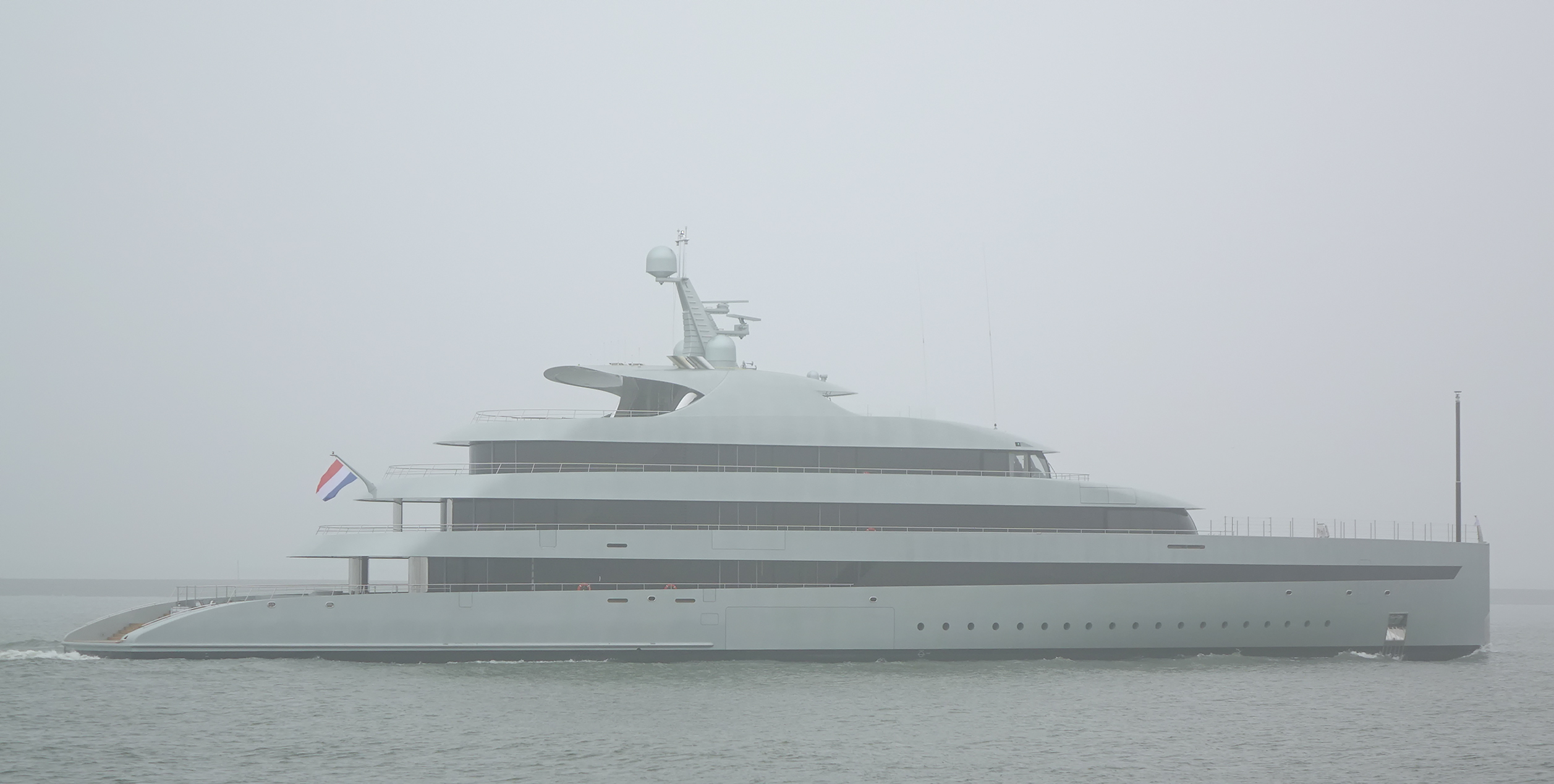
Historical image · Savannah in Hoek van Holland on sea trials · . This shows her appearance then, not her current condition.
Photo credit & licence
Photo: Kees Torn · Savannah · CC BY-SA 2.0
Unchanged original JPEG, displayed uncropped. No edits or resizing of the file.
The photographer identifies Savannah and records the passage towards the North Sea for trials. Identity reference. Reviewed .
This photograph records the yacht’s appearance when it was taken.
Photo: Kees Torn · Savannah · CC BY-SA 2.0. Unchanged original, displayed uncropped.
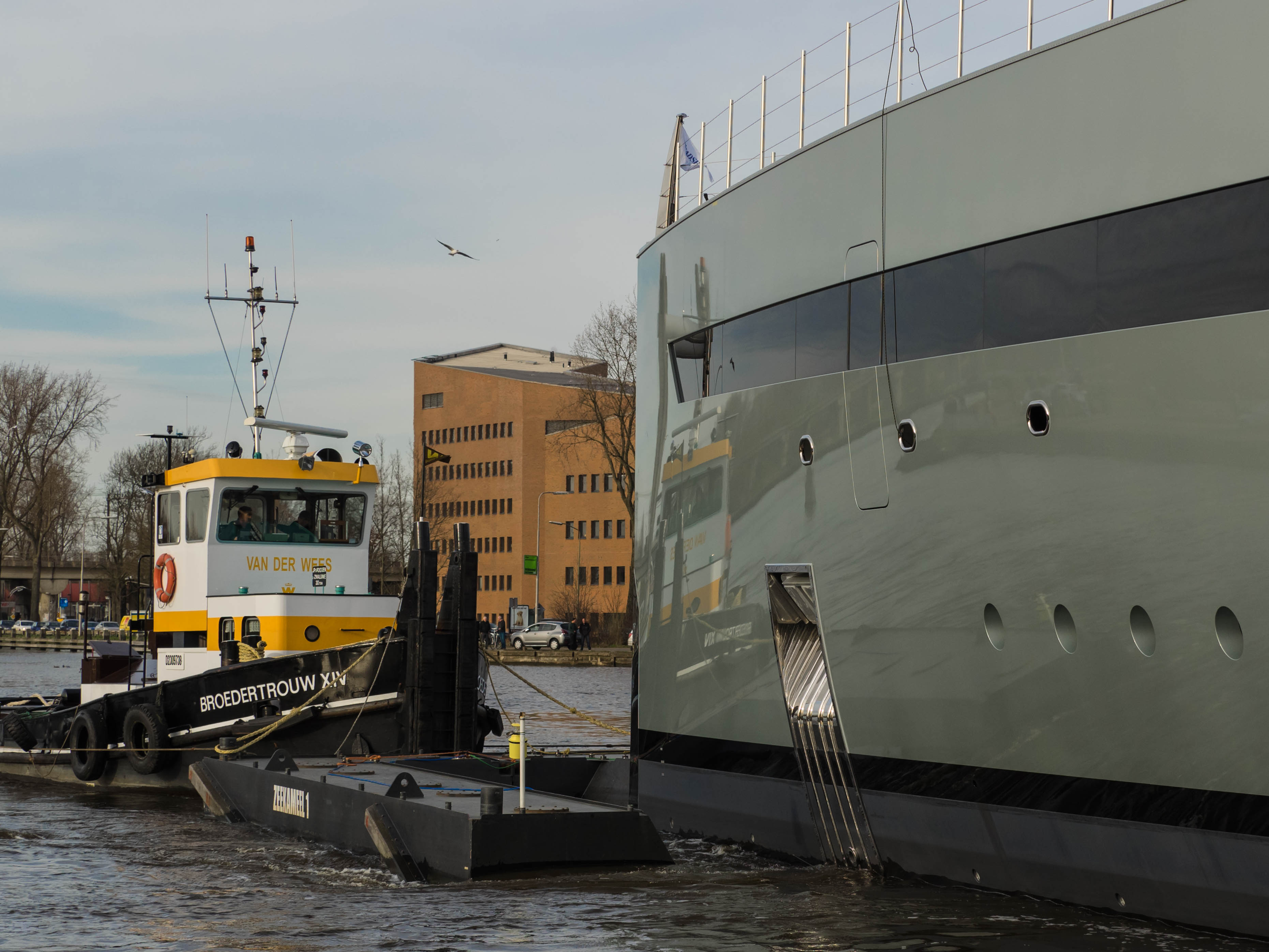
Historical image · Savannah in the Netherlands during her launch period · . This shows her appearance then, not her current condition.
Photo credit & licence
Photo: Frans Berkelaar · Luxury Yacht / Luxe jacht “Savannah” · CC BY-ND 2.0
Unchanged original JPEG, displayed uncropped. No edits or resizing of the file.
The original dated Flickr photograph names Savannah. The published file is the unchanged original under the NoDerivatives licence. Identity reference. Reviewed .
This photograph records the yacht’s appearance when it was taken.
Photo: Frans Berkelaar · Luxury Yacht / Luxe jacht “Savannah” · CC BY-ND 2.0. Unchanged original, displayed uncropped.