
Issue 1
Octopus had to be first
My dream boat is not the newest or shiniest. Look at what happens at her stern.
Research & acknowledgements
This profile is based on the sources linked alongside the relevant sections. Photograph credits and reuse details appear with each image.
The moment that caught me
Octopus had to be first. She is my dream boat. She is not the newest or shiniest yacht I could have picked, but there is so much to her that I keep coming back. I can already see myself meeting another boat in a few months' time and asking, almost without meaning to, how it compares with Octopus.
Start at her stern. In a photograph taken at the Kiel yard in 2003, there is a great dark opening just above the water. It looks less like a feature added to a yacht and more like the beginning of a different kind of vessel. What is all that space for?
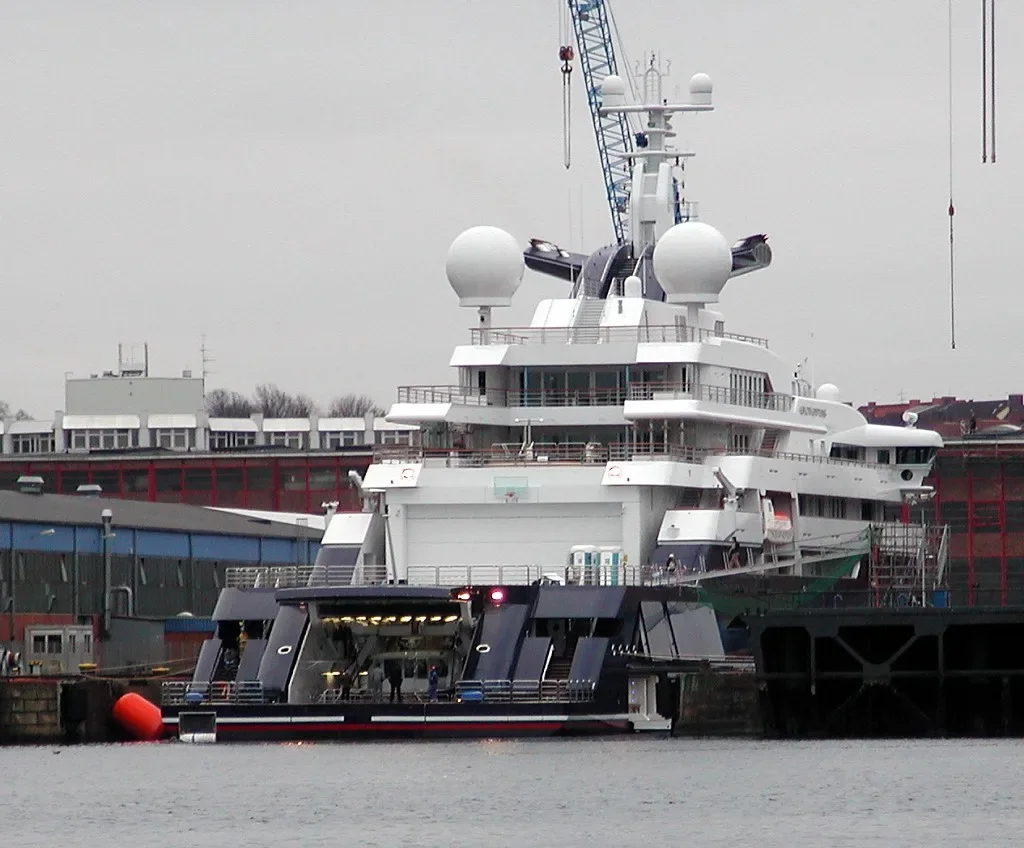
Octopus at the Kiel yard in 2003. The open stern shows the entrance to her internal dock.
View full photoPhoto: VollwertBIT · Original file · CC BY-SA 2.5
A proper look around
Lürssen, the builder, describes Octopus as 413 ft 5 in (126 m) long, with an integrated dock built to accommodate a principal tender around 65 ft 7 in (20 m) long and two underwater vehicles. Those are descriptions of the yacht's design, not a promise about what happens to be aboard today. Even so, think about the scale for a moment: the boat inside the boat would be substantial on its own. Its garage is part of the architecture, not a cupboard found after everything else was drawn.
The dock makes more sense when you follow an actual journey. In 2023, expedition operator EYOS's Ben Lyons spent five days aboard as a guest. He described a trip off Panama in which Octopus carried the group to the region, a large Delta tender took them around Coiba, and smaller Zodiacs reached into the mangroves. Each craft did a different job. The opening at the stern helps smaller boats reach places more easily than Octopus herself could.
The rabbit hole
Octopus has a history beyond carrying impressive equipment. Paul Allen's team reported that, in March 2015, it located the wreck of the Japanese battleship Musashi in the Sibuyan Sea. The search combined historical records, seabed mapping, an autonomous underwater vehicle and a camera-equipped remotely operated vehicle, with Octopus as the expedition platform. The team's own account also recognises the wreck as a war grave and the need to treat it respectfully. Later that year Octopus supported the recovery of HMS Hood's bell, a planned memorial project involving specialist partners. The Royal Navy later described its rededication in Portsmouth. The yacht made room for people and tools to do real work at sea. She did not do any of it alone.
Could we live on it?
Then there is the other question I want to ask of every boat in this series: could we live on her? A list of guest rooms, a cinema or a helipad cannot answer that. I want to know what a normal day feels like, where you would go for a quiet cup of tea, and how a boat designed for so many different jobs feels when nobody is staging a photograph. Lyons found the lounges more comfortable and intimate than he expected, but that was his account of five days, not my verdict. I have not been aboard. That question stays open.
For now, Octopus is the boat against which the others will have to make their case. Her stern is not just an extraordinary sight. It tells you what she was built to make possible. That is why I wanted us to begin here.
Keep looking
For the design, see Lürssen’s Octopus page. Octopus’s own history explains where the idea began. The charter manager’s listing shows the charter details currently advertised; availability and equipment can change.